Author: Marielle Mekkaoui

Risk as UX: Turning Risk Management Into Better Merchant Experiences

Every vertical SaaS company faces the same challenge: balancing growth with trust. As you embed payments directly into your platform, how you manage risk and fraud detection isn’t just a compliance concern – it’s a strategic choice that shapes your user experience.

When risk management becomes part of your embedded payments experience – not a barrier to it – everything accelerates. Onboarding moves faster. Merchants activate sooner. Platforms build lasting trust.

At Payabli, we believe risk is not a cost center – it’s an intelligence layer that fuels confident growth.

Our Pay Ops technology turns that intelligence into a competitive advantage – making risk visible, configurable, and actionable across the entire embedded payments journey, from onboarding to payment acceptance.

From Rules to Models: The Evolution of Risk Management

Most payment fraud detection systems start with static, rules-based monitoring – velocity checks, blocklists, or simple IP/geographic flags. Useful, but blunt. Modern risk management strategies require more intelligence.

Our Pay Ops solutions take that foundation and layers in machine learning–driven risk scoring, contextual policy orchestration, and agentic automation to transform risk from a reactive process into a proactive experience layer.

This proactive approach starts the moment a merchant within your platform signs up. By embedding intelligent risk evaluation into onboarding, SaaS platforms can verify, segment, and activate merchants confidently – minimizing fraud while maximizing flow.

Beyond Transactions: Risk Management Strategies Across the Full Merchant Lifecycle

True risk management extends far beyond authorization. Payabli embeds intelligence into every stage to facilitate continuous protection for platforms that feels seamless:

Onboarding & Underwriting: Dynamically verify business data and flag risk factors in real time. Adaptive pathways fast-track trusted merchants while escalating suspicious cases for review.

Transaction Monitoring: ML-powered scoring synthesizes velocity, geo-location, and behavioral signals into explainable risk scores that dynamically approve, hold, or block.

Payout Controls: Volume-based rules monitor ACH exposure. If payouts exceed thresholds, the system holds funds or triggers review – protecting platforms without disrupting cash flow.

Continuous Merchant Intelligence: Continuous monitoring tracks chargebacks, refunds, and exposure trends. When patterns shift, automated triggers adjust rules or prompt re-underwriting.

Together, these capabilities transform your SaaS platform into a full-lifecycle risk system – one that turns risk management into a competitive advantage by aligning it directly with user experience. 

Rules Engine, Reimagined

At Payabli, we’ve built a powerful orchestration engine that allows multiple outcomes – alert, hold, block – for every transaction. Instead of rigid “yes/no” logic, our risk model dynamically adapts to behavior, generating explainable transaction records for every decision.

That same flexibility applies during the merchant onboarding process. Risk signals inform adaptive pathways: fast-tracking trusted merchants for quick approval while automatically escalating suspicious cases for review. 

The result? Smarter protection that feels invisible. This is “Risk as UX” in action, providing protection that works quietly behind the scenes.

Customizable Risk & Onboarding Policies

Every vertical SaaS platform operates differently. Payabli lets SaaS platforms define risk and onboarding policies at the organization or merchant level – tightening controls for new or high-risk accounts while allowing flexibility for established, trusted merchants.

This contextual control transforms what’s often seen as friction into a feature. Merchants feel seen and understood, while SaaS platforms maintain the guardrails that keep ecosystems healthy. Risk and experience move in sync.

Make Smarter Decisions with Risk Scores: Context You Can Act On

At the heart of our Payment Operations platform (Pay Ops) is our Risk Scoring Model, an advanced payment fraud detection engine that generates merchant scores and per-transaction scores to quantify potential fraud or loss.

This risk scoring approach is built from multiple layers of intelligence:

  • Transaction patterns (velocity, frequency, amount anomalies)
  • Merchant-level history (chargebacks, refunds, exposure trends)
  • Device and location signals (geo mismatch, IP diversity)
  • Behavioral and vertical data unique to each merchant’s industry

The result is an explainable, transparent score – not a black box. SaaS platforms can view sub-scores for AML risk, transaction anomalies, and fraud probability, with clear reasoning behind each outcome.

Transparency here is UX. When merchants understand why they’re being verified or approved, it builds confidence and reduces drop-off – turning compliance moments into trust moments.

Today, Payabli’s teams are shadow-scoring all transactions internally – a step toward offering these insights directly to SaaS platforms managing their own exposure and onboarding workflows.

AI-Powered Policy Creation and Triage

Managing risk across hundreds of merchants can overwhelm even the best teams – but when risk intelligence is automated, it becomes part of the experience rather than an interruption.

Payabli’s AI-driven agents continuously monitor and triage fraud alerts in real time. When potential card-testing events occur, these agents:

  • Cluster related alerts
  • Detect patterns (multiple BINs, IP variations, timing spikes)
  • Surface summarized context directly in Slack
  • Recommend actions like “hold,” “review,” or “safe to ignore”

This turns a flood of alerts into one intelligent conversation – letting human reviewers focus on what matters most. In practice, that means fewer interruptions, faster decisions, and a more seamless merchant experience from onboarding to payment acceptance.

Building the Next Layer: Risk Management as a Product

In many ways, Payabli has built its own version of Stripe Radar – but purpose-built for vertical SaaS platforms. Because our Pay Ops infrastructure is modular, platforms can decide how deeply to integrate the risk layer:

  • Base: Internal risk monitoring and fraud alerts
  • Advanced: Per-transaction risk scores and custom rule policies
  • Enterprise: Co-managed risk operations and AI-driven triage

Over time, these capabilities don’t just reduce losses – they unlock new revenue. Vertical SaaS platforms can monetize advanced merchant monitoring, loss liability protection, or transaction scoring, using Pay Ops as the engine behind it all.

Why It Matters for Vertical SaaS Platforms

Owning the full payments experience means owning the risk that comes with it – but also the trust it creates. When risk management is designed as part of the user experience, SaaS platforms can:

  • Onboard merchants faster with confidence
  • Reduce fraud losses without adding friction
  • Protect merchants through explainable, real-time risk data
  • Automate reviews to keep workflows smooth
  • Build trust through transparency and control
  • Monetize operational intelligence as a premium service

This is the future of risk management – invisible infrastructure that quietly powers exceptional experiences.

Let’s Build Your Risk Management Strategy Together

The next generation of vertical SaaS platforms will win not just by managing risk – but by embedding it into the user experience. Payabli helps you transform compliance into confidence and risk operations into growth levers. If you’re building the future of embedded payments, we’d love to help. Schedule a demo to start shaping your risk management strategy today.

Preparing for the Agentic FinTech Future: Payabli’s AI-Native Transformation

I’m Ankita, AI Product Lead at Payabli. I came into fintech from outside the industry, which means I ask a lot of “why do we do it that way?” questions. Here, I write about building AI systems that actually work—for our team, our customers, and the emerging world of agentic fintech.

When I joined Payabli six months ago, the company had already embraced AI with an impressive toolkit—ChatGPT, Claude, Cursor, Gemini, and more. Teams were actively using AI for writing, brainstorming, and research, signaling a strong foundation and a real appetite for innovation.

But I also saw an opportunity to go further. While people were using AI tools, they weren’t yet experiencing the transformative upside. Many workflows still relied on manual processes begging for automation, and teams wanted clearer direction on how AI could fundamentally reshape the way fintech work gets done.

Fast forward six months: we’ve built a suite of AI agents operating across the organization, contributing to more than 24 hours of manual work saved every week. We’ve consolidated our toolset to streamline learning, training, and sharing of best practices. And we’ve begun laying the groundwork for what we believe is the next frontier in the industry—agentic fintech, where autonomous systems handle operational complexity so humans can focus on strategy, relationships, and innovation.

This is how you evolve into a truly AI-native organization.

Start With a Clear Picture: Assessing Real AI Adoption

You can only fix what you can measure, so I started by getting a clear picture of Payabli’s AI usage.

Through surveys, conversations with team leads, and benchmarking with industry counterparts, I discovered that 75% of the company was using AI automations daily – a strong starting point. However, employees were working across various AI tools, and that fragmentation was holding us back. Training was inconsistent. And most importantly, teams were focused on surface-level use cases instead of the deep automation and integration work that would deliver real impact.

Automate the Pain Points First

My approach to demonstrate the latent value of AI was simple: identify the most time-consuming manual processes, automate them, and build a portfolio of proof points. Often people aren’t opposed to AI adoption – they just don’t even realize it can solve their specific problem.

I started with the low-hanging fruit – the repetitive, time-intensive tasks that were taking up hours of employee time and built tools to automate them:

  • Chargeback AI Agent: Handles routine email responses, collaborates with human analysts on complex chargeback cases, and tracks action items – reclaiming hours previously spent on manual work.
  • Engineering Ticket Monitoring: Automates the monitoring of support tickets to ensure high-quality descriptions that speed up engineering output.
  • Sales Lead Qualification Tool: Automatically evaluates new customer leads against our criteria and notifies the sales team directly in their email inbox

These AI automations became our proof points. Everyone could see the tangible impact – colleagues reclaiming hours each week, faster response times, higher quality outputs – all within their existing tools. More importantly, it shifted the conversation from “Can AI help?” to “What should we automate next?”

Build AI Literacy, Not Just AI Tools

As important as it was to build automations, it was equally critical to create shared understanding around how AI should be used across the company. You don’t become an AI-native organization by deploying tools alone – you get there by ensuring every employee knows how and when to use AI to accelerate their work.

To support that shift, I created comprehensive internal AI documentation that outlines how we use AI at Payabli, including:

  • Guidance on when to use different AI assistants — for research, analysis, content creation, or structured workflows.
  • Instructions on leveraging our integrated workspace tools, including web search, database search, and project management.
  • How to create specialized AI agents with custom instructions and knowledge bases
  • Examples and frameworks employees can follow to identify automation opportunities in their own workflows.

The goal was not just to share information, but to instill an automation-first mindset across the organization. Instead of stopping at low-hanging fruit, employees now have tools and frameworks that help them consider where AI can meaningfully speed up processes or improve quality.

AI literacy isn’t a one-time initiative – it’s a cultural shift. By documenting, training, and creating space for experimentation, we gave every employee the confidence and skills to ask a powerful question: “How can AI make this faster?”

That’s when the real transformation began.

Turning Internal AI Wins Into Customer-Facing Innovation

AI automation delivers incredible value for internal teams, but the real opportunity is when you can extend that value to customers and enhance your product. Coming into fintech with fresh eyes helped me identify where we could make the biggest impact using AI virtual assistants.

I scoped several AI-powered features currently in development for Payabli’s 2026 production release, including:

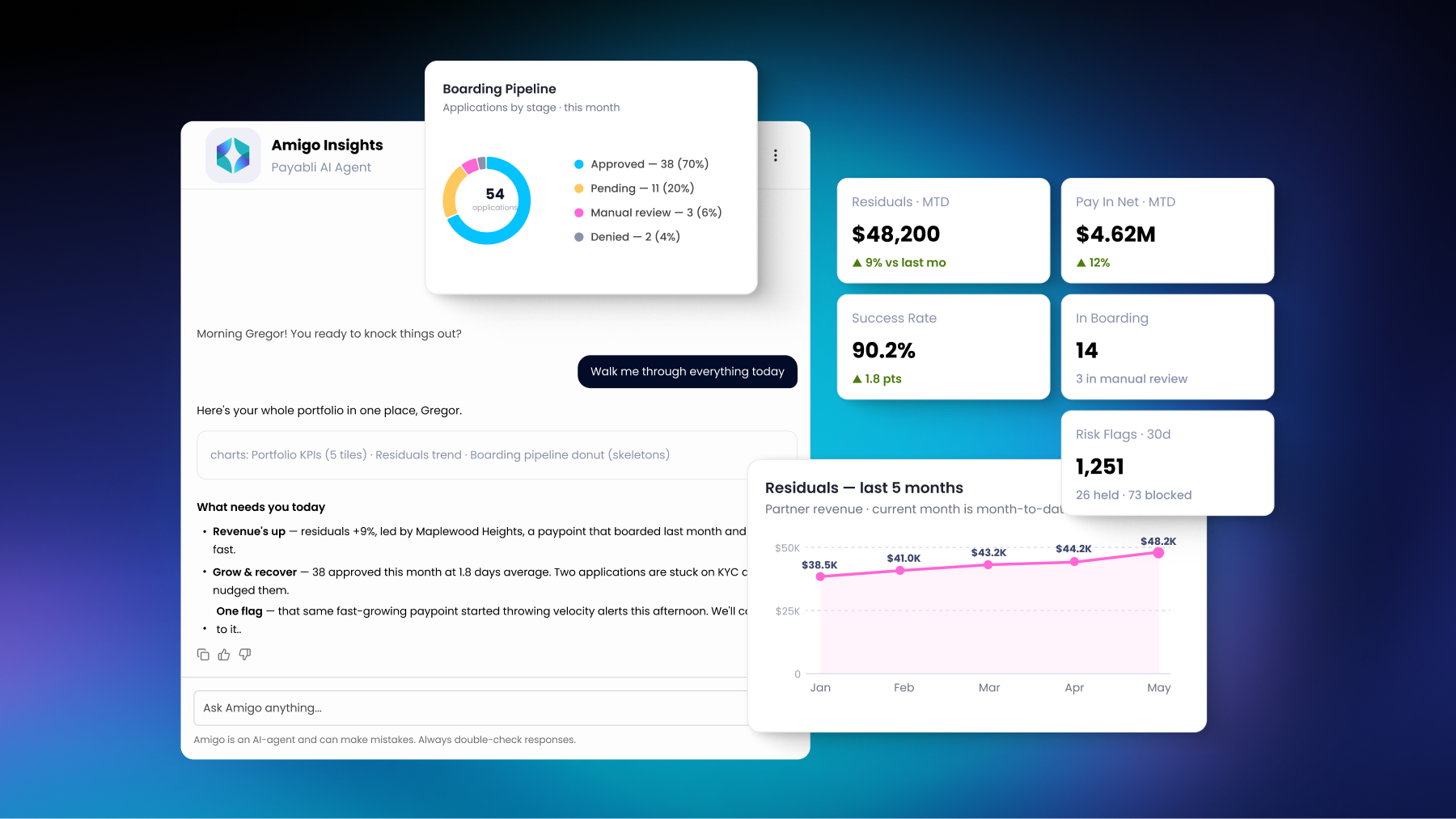
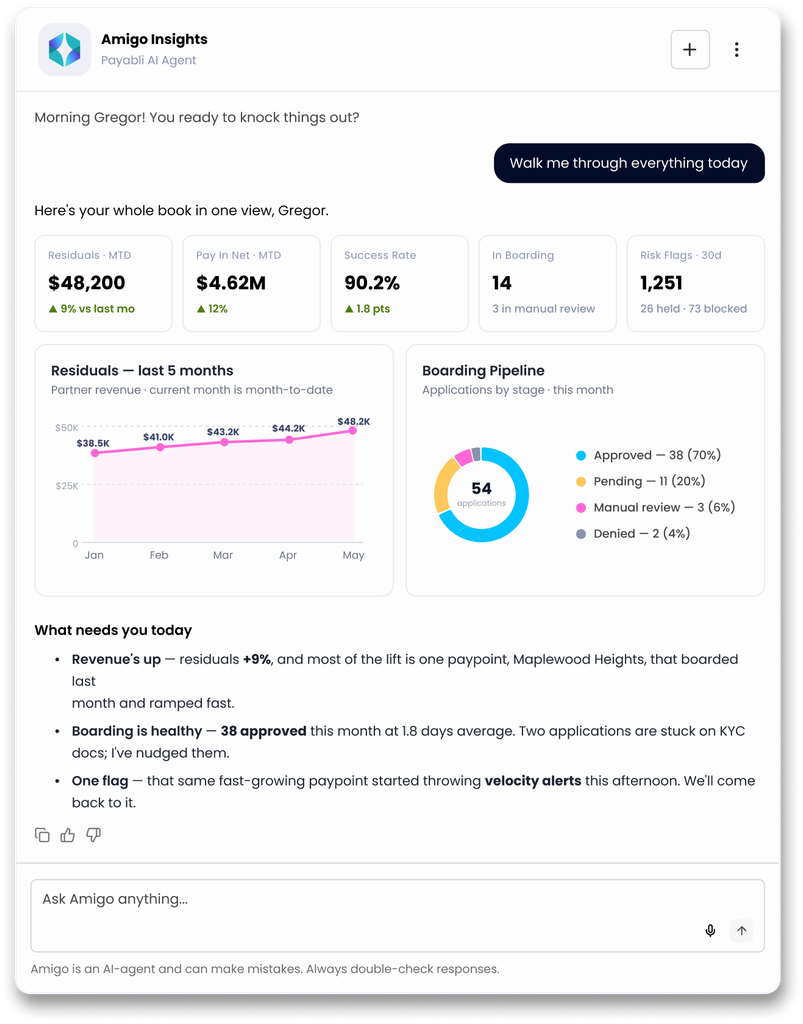
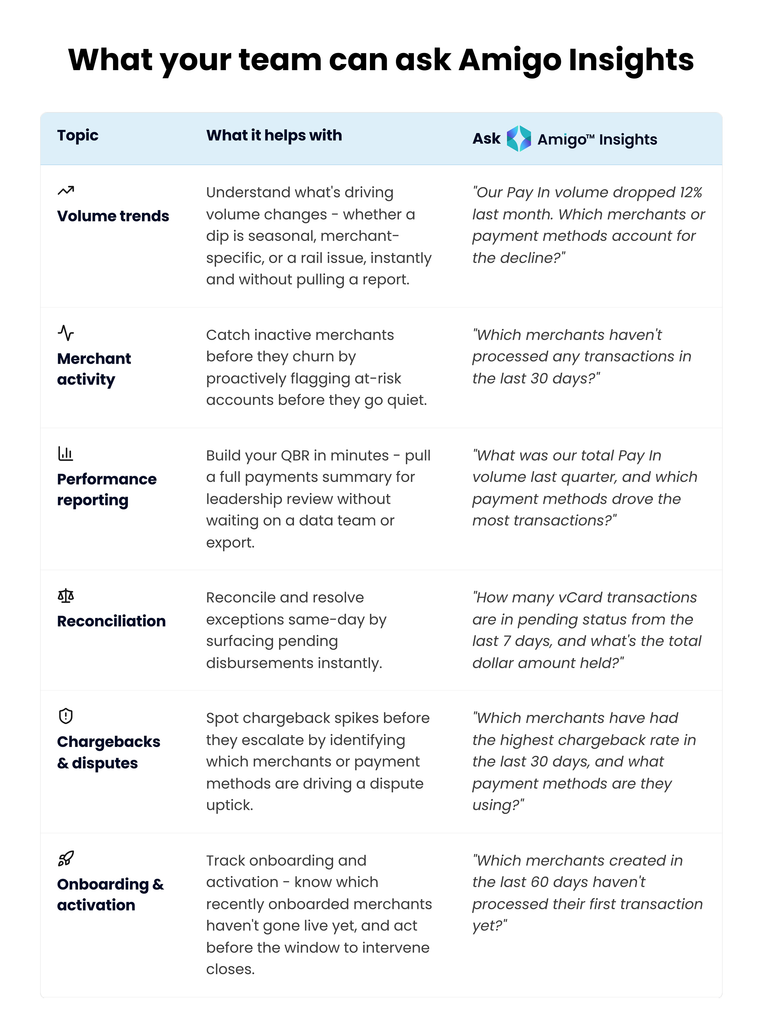
  • Analytics AI Agent – “Amigo,” Payabli’s embeddable chatbot, helps SaaS platforms quickly ask questions about transactions, identify trends, and find ways to improve their business.
  • Vendor Enablement AI Agent – Helps merchants pay vendors faster by using an AI voice agent to encourage vendor enablement and determine payment preferences.
  • Risk Scoring AI Agent – Machine learning models to score incoming transactions with an AI agent on top that conducts initial reviews and surfaces high-priority items for analyst investigation.

The key is identifying the highest-leverage areas for AI automations – not just adding it where it looks impressive. To effectively lead Payabli towards becoming an AI-native organization, I prioritize opportunities based on potential time savings, competitive differentiation, customer need, and strategic alignment.

Envisioning the Future of Agentic Commerce

Building for today isn’t enough – a big part of my role is anticipating where the industry is headed and positioning Payabli to lead that shift.

The agentic commerce wave is coming. AI agents will soon handle complex purchasing decisions autonomously – but there’s a problem: while e-commerce is racing to become AI agent-ready, the services industry isn’t getting as much attention. Service merchants lack the API infrastructure and tooling that would make them discoverable and transactable by AI agents.

That’s the gap we’re filling. We’re developing a strategy to ensure service-based businesses have what they need to participate in this shift – from merchant enablement toolkits to new payment token infrastructure designed for agent-driven transactions.

The AI-powered features we’re building now – risk scoring agents, vendor enablement voice agents, analytics capabilities – aren’t just standalone products. They’re building blocks for a future where payments infrastructure is intelligent by default and services are as accessible to AI agents as consumer products are today.

The possibilities ahead are endless, and we’re still early. Creating the mindset shift where every employee starts by asking “how can AI help?” has positioned Payabli to become a leader in AI-native payment infrastructure as the fintech industry continues to transform. There’s tremendous potential ahead for how we continue infusing AI into our product and organization – and we’re just scratching the surface.

Coffee with a Founder Podcast: Jo Phillips and Will Corbera of Payabl

On this episode of Coffee with a Founder, Beck Bamberger sits down with Jo Phillips and Will Corbera, Co-Founders and Co-CEOs of Payabli.

Jo and Will open the conversation by sharing their journey to founding Payabli together—from recognizing the massive gap in how software companies manage and monetize payments, to realizing they were uniquely aligned in vision, chemistry, and conviction. Their story highlights the complementary strengths that brought Payabli to life and the shared belief that fintech infrastructure needed a better, bolder approach.

They also dive into the leadership philosophies and cultural principles that fuel Payabli, walking through the company’s core values:

  • Team First: Investing in people to build a culture where everyone loves showing up each day.
  • Customer Love: Wooing customers so fully that they feel compelled to write love letters.
  • Small Giant: Prioritizing purpose and long-term thinking as Payabli grows sustainably.
  • Run to the Fire: Leaning into hard problems and doing the right thing, even when it’s tough.
  • Bias for Action: Moving with urgency and never postponing what can be done today.
  • Little Things Count: Elevating the Payabli experience through thoughtful, detail-driven touches.
  • Punch Above Our Weight: Using nimbleness as a strategic advantage—and competing with confidence.
  • Truth Seekers: Valuing honesty, accountability, and open communication over ego.

Throughout the episode, Jo and Will share what personally motivates them as they navigate the highs and lows of startup life, and how these values guide them as leaders in a fully remote world.

A powerful look at the heart, mindset, and mission behind our team at Payabli.

Ghost Cards: Turn Vendor Payouts Into Your SaaS Platform’s Highest-Margin Revenue Stream

For Vertical SaaS Platforms powering embedded payments, Ghost Cards are emerging as a powerful solution to an often-overlooked challenge – the Pay Out side of the equation. While many platforms obsess over Pay In optimization—perfecting card acceptance, reducing friction, and maximizing conversion—vendor payouts frequently remain manual, fragmented, and inefficient. Ghost Cards streamline this process, unlocking automation, control, and scalability on the Pay Out side that matches the sophistication of Pay In.

But as platforms scale, this oversight becomes costly.

Fragmented payout processes create friction that frustrates customers and erodes trust:

  • Critical payments missed or delayed due to manual vendor setup errors – One data entry mistake means a contractor doesn’t get paid on time, jeopardizing your customer’s relationship with their supplier.
  • Card-on-file vendors won’t accept ACH or checks – Some vendors only accept card payments, forcing your customers to maintain multiple payment systems or lose access to preferred suppliers.
  • Payment rail mismatch sends checks or ACH to card-enabled vendors – Every mismatch between vendor preferences and your default rails creates friction, delays, and support overhead that drains resources.

These aren’t edge cases – they’re everyday realities that create support tickets, damage customer satisfaction, and leave revenue on the table.

What if you could eliminate these headaches while turning payouts into your platform’s highest-margin revenue stream?

That’s what Ghost Cards make possible.

What Are Ghost Cards?

A Ghost Card is a multi-use virtual card issued to a vendor for ongoing payments. Unlike single-use virtual debit cards, Ghost Cards can be tied to specific vendor relationships – making them ideal for recurring invoices, supplier contracts, and repeat service providers.

They function like any traditional credit or debit card – only faster, safer, and fully digital.

In short: Ghost Cards let your platform issue one card per vendor, automating recurring payments while maintaining full control.

Why Ghost Cards Are a Game-Changer

Ghost Cards don’t just simplify how vendors get paid – they monetize the entire payout flow.

Because they operate on card rails, Ghost Cards generate significantly higher interchange revenue than ACH or check payments – often outperforming even your Pay In monetization.

But the advantages go beyond revenue:

  • Recurring & Multi-Use – One card per vendor makes paying repeat suppliers simple, automated, and efficient so that a critical payment (like a utility bill) is never missed.
  • Configurable Controls – Set spend limits, restrict merchant categories, and control expirations.
  • Instant Funding – Credit or good-funds models eliminate ACH delays.
  • White-Labeled – Brand every transaction with your platform’s logo.
  • Unified Reporting – Full visibility and reconciliation from your dashboard.

With Ghost Cards, platforms don’t just process payments – they control the entire payout experience.

Ghost Cards vs. Virtual Debit Cards

CategoryVirtual Cards (Single-Use)Ghost Cards (Multi-Use)
UsageOne-off vendor paymentsRecurring vendor relationships
ControlBasic (single transaction)Advanced (limits, MCC, expirations)
Vendor ExperienceOne card per paymentOne card for ongoing payments
ReconciliationHarder to match to invoicesEasier, tied to vendor account

Ghost Cards extend the capabilities of traditional single-use virtual cards – enabling automation, better visibility, and ongoing profitability.

Who Benefits Most from Ghost Cards

Ghost Cards are ideal for Vertical SaaS platforms serving industries that manage recurring vendor relationships and frequent supplier payments.

Use Cases:

  • HOA & Property Management – Pay recurring contractors like landscapers and maintenance crews.
  • Healthcare – Streamline payments to repeat suppliers for medical equipment and consumables.
  • Education – Issue recurring payments to transportation, IT, and facility vendors.
  • Field Services & Construction – Manage ongoing payments to subcontractors, materials suppliers, and rental companies.
  • And Many More – Any vertical with recurring vendor relationships benefits from Ghost Cards’ flexibility and control.

By simplifying these recurring payouts, Ghost Cards improve vendor satisfaction while driving consistent platform revenue.

Turn Recurring Payouts Into Recurring Profits

Ghost Cards give SaaS platforms a double advantage:

  • They empower businesses with faster, more secure vendor payments.
  • They unlock recurring, high-margin revenue from every payout – with significantly higher interchange revenue than ACH or check payments. 

Instead of handing off payouts to traditional banks or third-party processors, your platform becomes the hub for every transaction – earning more revenue while delivering a better vendor experience.

With Ghost Cards, payouts aren’t just a back-office process – they’re a growth engine.

Start Monetizing Vendor Payments Today

Ready to own your payout experience and maximize your revenue potential? Book a demo or talk to our team about Ghost Cards and start turning payouts into profit.

Escape the Haunted Maze of Vendor Payouts and Find the Sweet Path to Profitability with Payabli Ghost Cards

Managing vendor payouts is one of the most overlooked opportunities for SaaS platforms to drive profitability. The right payout strategy can transform operations, improve vendor relationships, and unlock new revenue streams – but only if you’re leveraging the full range of modern payment options available.

At Payabli, we offer comprehensive payout solutions to match your vertical SaaS platform’s unique needs – from traditional Virtual Card, ACH, check, and wire transfers for one-time payments, to our innovative Ghost Cards for recurring vendor payments.

Ghost Cards are multi-use, virtual debit cards specifically designed to automate ongoing vendor expenses while generating interchange revenue with every transaction. For SaaS platforms managing embedded payments, vendor disbursements, or supplier payouts, Ghost Cards turn what was once a cost center into a profitable revenue engine.

We created this fun, Halloween-themed infographic to help you navigate the payout maze. Every vertical SaaS platform faces the same choice: which payment method fits which use case? Traditional methods have their place, but for recurring vendor payments, Ghost Cards are the clear path to automation, enhanced controls, and meaningful monetization.

Download the infographic here.

10x Impact: Inside Payabli’s Documentation Revolution

Six months into joining Payabli, I had already migrated us to a new documentation platform, integrated AI-powered chat, and started filling the gaps in our documentation. 24 months later, we’ve transformed from sparse, founder-run docs into hundreds of pages of content, over 200 documented API endpoints, six auto-generated SDKs, and multiple example applications.

This wasn’t about throwing bodies at the problem. For most of this journey, I worked solo. Even now, we’re just two people. The 10x improvement came from ruthless prioritization, smart tooling decisions, and building systems that scale without constant human intervention.

Here’s what actually worked.

Choose tools that let you innovate, not tools that need babysitting

The first major decision was migrating to a new documentation platform within three months of starting. The previous setup couldn’t support where we needed to go.

I wanted flexibility without being on call. At a previous job, I’d maintained self-hosted documentation, and it was miserable—I was spending time on package updates and infrastructure instead of actually improving docs. I knew I didn’t want that again, at least not until we had a much larger team.

We chose managed solutions that gave us room to innovate without the operational burden. This single decision freed up countless hours to focus on content, architecture, and automation instead of keeping the lights on.

The platform needed to support our vision and support custom components, sophisticated information architecture, and give us the ability to move fast. It delivered on all of those. The tradeoffs are some limitations on customization, but we’re also spared dealing with PagerDuty for a documentation site.

Build automation for everything you touch twice

When I found myself manually updating card components across dozens of pages (and making typos in links and titles) I knew it was time to automate. That’s when I started building our documentation CLI.

The CLI has become central to how my team operates. It eliminates entire categories of manual work and human error. It’s a living tool that we frequently add to and subtract from as our needs change.
Some examples:

Automatic component generation: All the card components in our docs are generated automatically based on frontmatter in our pages. Change a page title, and the cards that reference it update automatically. No more broken links or outdated references.

Diagram synchronization: We use sophisticated text-based diagramming, and our CLI includes automated checks that update the generated SVGs whenever the diagram source changes. We automated it so we no longer forget to update the images when the source changes.

Changelog automation: When I change our API definition, I run a command that writes the changelog entry and flags whether it’s a breaking change. This triggers the right SDK builds automatically.

These aren’t flashy features. They’re boring infrastructure that compounds over time. Every manual task you automate is time you get back for higher-leverage work, and mistakes you never make again. I want to use my brain on big problems, not little tasks.

Integrate AI where it actually helps

We integrated Inkeep early, and the chat bot has delivered an 80-100% deflection rate every month. Customers can ask questions like “build me a config for this service,” and the chat generates working configurations from our documentation.

But the real value isn’t just answering questions. I read every chat conversation and analyze how customers ask for help. This reveals gaps in our docs that I wouldn’t see otherwise. When I notice patterns, I update the documentation to address those questions proactively.

The AI chat has become a continuous feedback loop: customers ask questions, I identify documentation gaps and read customer feedback, I improve the docs, and future customers find answers faster. It’s transformed self-service for our customers and made our documentation measurably better.

Hire for potential and trajectory, not just experience

Eighteen months in, I hired Elijah, my first team member. I made a choice: I technically needed a writer to help take some of my workload, but instead I hired a junior developer who I could train to write.

I wanted someone who would grow into a developer relations role. I needed someone who could hit the ground running to build SDKs, create example applications, talk to developers, and understand their needs at a deep level. That meant I needed an extroverted developer first, writer second.

It was challenging. He was very junior, and I had to teach him about the payments industry and technical writing fundamentals. But, at the 90 day mark, he’d already shipped resources that would be difficult for a non-developer to create. The best part is that none of the resources he created required anything from other teams.

Elijah’s role here helps my team execute quickly on building enablement resources

Treat information architecture as a competitive advantage

When I say I focused on information architecture (IA), I mean I obsess over navigation, our controlled vocabularies, content categories, URLs, keywords, and more. Prioritizing IA has been central to our ability to scale because good IA is scale.

Good IA means customers can find what they need quickly. It means new content fits logically into existing structures. It means the documentation grows in an organized way instead of becoming a sprawling mess.

This isn’t something you do once. It’s continuous work as your product evolves, as you add content, and as you learn how customers actually navigate your docs. We recently put a lot of work into reconfiguring the entire documentation site to use Fern’s new product switcher, because that feature made it easier to organize our own content by audience type.

Measure what matters, then read between the lines

Beyond the AI chat analytics, I use PostHog for product analytics on the documentation site. This shows us how people interact with different elements, which pages aren’t performing well technically (slow to load, component errors), and where people get stuck.

We track GitHub stars for our SDKs. We monitor standard web analytics for visits and engagement. But qualitative analysis like reading actual chat conversations, looking at heatmaps, or watching how people navigate, often reveals more than the numbers alone.

Metrics tell you what’s happening. Understanding why requires digging deeper.

Work with the team you have, not the team you wish you had

The biggest ongoing challenge is working with internal teams who are stretched thinner than we are. It’s hard to be proactive and reach out to teams who may not be able to  prioritize reaching out to us.

This is still something we’re navigating. I’ve made looping us in on work frictionless (just add a label to a ticket and the Doc team appears). My team has adopted the QA team’s tools so we can self-service more information and test our docs. Our automation efforts helped because we could do more with less. 

You can’t change how busy other teams are. You can only change how much you depend on them having spare time to help you.

Would I do anything differently?

No. I built our docs program the way Payabli needed it done, given our constraints, resources, and goals. Not every approach works in every context.

If you’re a solo documentarian or a small team trying to scale impact, here’s what mattered most for us at Payabli:

Pick your infrastructure carefully. Choose tools that let you focus on high-leverage work, not maintenance. We love our stack, and you should too.

Automate relentlessly. Every repeated manual task is technical debt. Build the tooling to eliminate it.

Hire for the gaps you can’t fill alone. Think about what skills will unlock the most value, not just what’s easiest.

Treat information architecture as ongoing work. It’s not a one-time project. It’s how you prevent your docs from collapsing under their own weight as you scale.

Build feedback loops. Use AI, analytics, and conversations to understand where your documentation is failing customers, then fix it.

We went from founder-run docs with missing pages and outdated content to hundreds of pages, 200+ documented endpoints, six SDKs, and multiple example applications. We did it with two people because we built systems that scale for Payabli.

That’s how you 10x a documentation team: not by 10x-ing headcount, but by 10x-ing leverage.


If you enjoyed these insights on how we’re leveling up our docs, why stop here?
Check out Payabli’s Developer Documentation to see it all in action — cleaner guides, smarter structure, and the little details that make a big difference for platforms and developers building with Payabli.

Vendor Payouts: The Untapped Revenue Driver for SaaS

Vendor payouts aren’t a cost to manage – they’re a revenue opportunity to capture. By owning and monetizing payouts alongside payments, vertical SaaS companies can unlock new margins, deepen platform stickiness, and build durable competitive advantages.

Vendor payouts for SaaS platforms aren’t just an operational cost; they’re an untapped revenue opportunity. By owning and monetizing payouts alongside payments, vertical SaaS companies can unlock new margins, deepen platform stickiness, and build durable competitive advantages.

Most SaaS leaders obsess over how money flows in, optimizing checkout, reducing friction, and capturing every basis point of margin. But here’s the question few ask: are you leaving money on the table every time your platform sends money out to vendors?

When vendor payouts are treated as a back-office afterthought, outsourced through third parties and forgotten, a revenue stream quietly walks out the door. Every payout your platform processes is a transaction, and every transaction is a chance to capture margin, strengthen vendor relationships, and create a deeper competitive moat.

The SaaS platforms that recognize the power of embedded vendor payouts aren’t just cutting costs; they’re capturing new revenue streams, improving retention, and transforming how value flows through their ecosystems.

The Missed Opportunity Sitting in Plain Sight

Think about your vertical SaaS platform for a moment. You’ve built the central nervous system of an ecosystem – connecting buyers with sellers, customers with service providers, businesses with contractors. Money flows in when customers pay. But it also flows out when vendors get paid.

Most vertical SaaS companies have nailed the “Pay In” side – they’ve integrated payment processing, optimized checkout experiences, and captured the associated economics. But when it comes to “Pay Out“, the story is very different.  Most embedded payment providers don’t offer robust payout capabilities, if any at all – and most SaaS platforms haven’t even thought to ask for them.

This oversight in your payments strategy can come with significant costs: 

  • Missed revenue: Every payout is a transaction that could carry margin – often with higher returns than ACH, checks, or your platform’s payment acceptance revenue
  • Critical payments missed/delayed: Without reliable payout infrastructure, essential vendor payments can fail – meaning contractors don’t show up and suppliers cut off services. For your customers, unreliable payouts threaten operational continuity and their ability to keep the lights on.
  • Weakened user experience: Your customers expect seamless, modern payment experiences. Why shouldn’t your vendors? Disjointed payout processes create friction, reduce satisfaction, and weaken platform stickiness.
  • Loss of control: Managed payables limit flexibility in how and when payments are made, stripping SaaS platforms of valuable control in tailoring workflows to their verticals.

The bottom line? Every vendor payment is an opportunity to earn revenue, strengthen your platform, and deliver a better customer experience.

How Vendor Payments Actually Generate Revenue

Here’s what most SaaS leaders don’t realize: vendor payments aren’t just about moving money from Point A to Point B. They’re about how you move it – and each method carries its own revenue opportunity:

  1. Virtual CardsThe highest revenue generator.
    • Vendors are paid via a single-use, digital credit card number. SaaS platforms earn interchange revenue on these transactions, which can be significant. Virtual cards also deliver faster settlement and added security.
  2. ACH TransfersA balance of speed and cost.
    • ACH is often preferred for recurring vendor relationships. While margins are lower than virtual cards, SaaS platforms can still monetize ACH through per-transaction fees or premium options like same-day ACH.
  3. ChecksLegacy, but still relevant.
    •  Though less efficient, some vendors prefer checks. SaaS platforms can capture margin through check-issuance fees while meeting vendors where they are.

By offering all three methods – and capturing economics from each – you transform vendor payments from a cost center into a profit center. You generate new revenue from every dollar flowing out while giving vendors the flexibility, speed, and choice that builds loyalty.

Why Payabli Is Different

Most payment providers focus on one side of the transaction: Pay In or Pay Out. Even those that claim to do both typically treat payouts as an afterthought – just wiring funds, sending checks, or pushing an online payment – forcing SaaS platforms to give away both the economics and the experience.

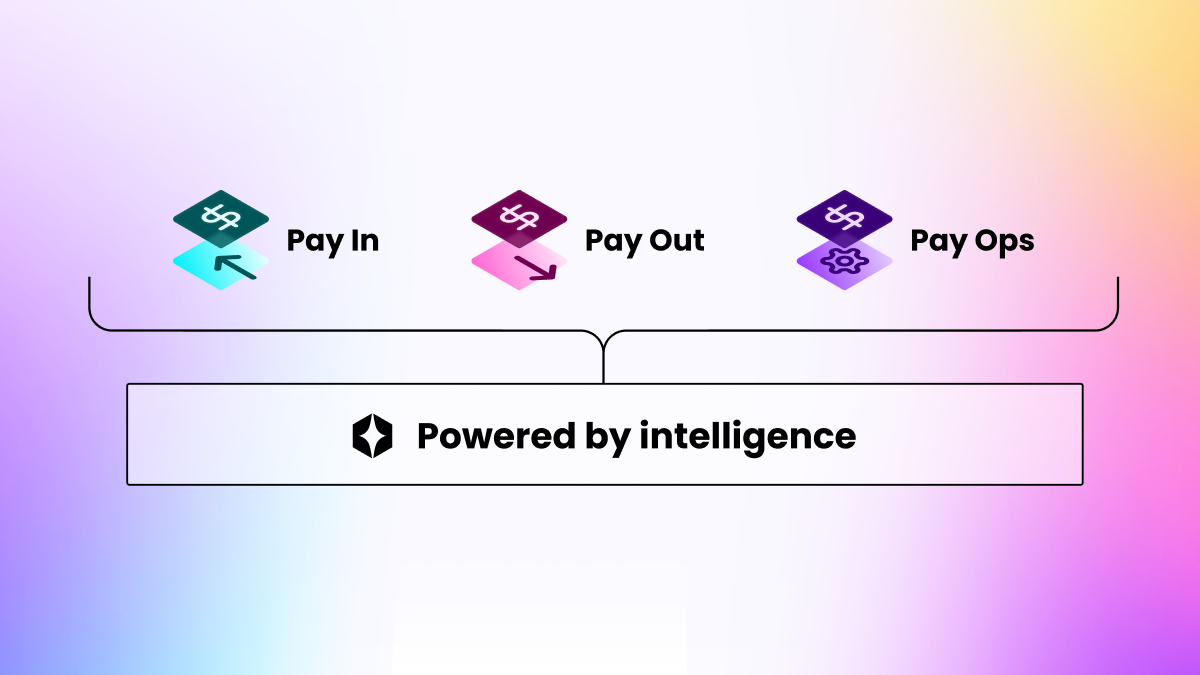
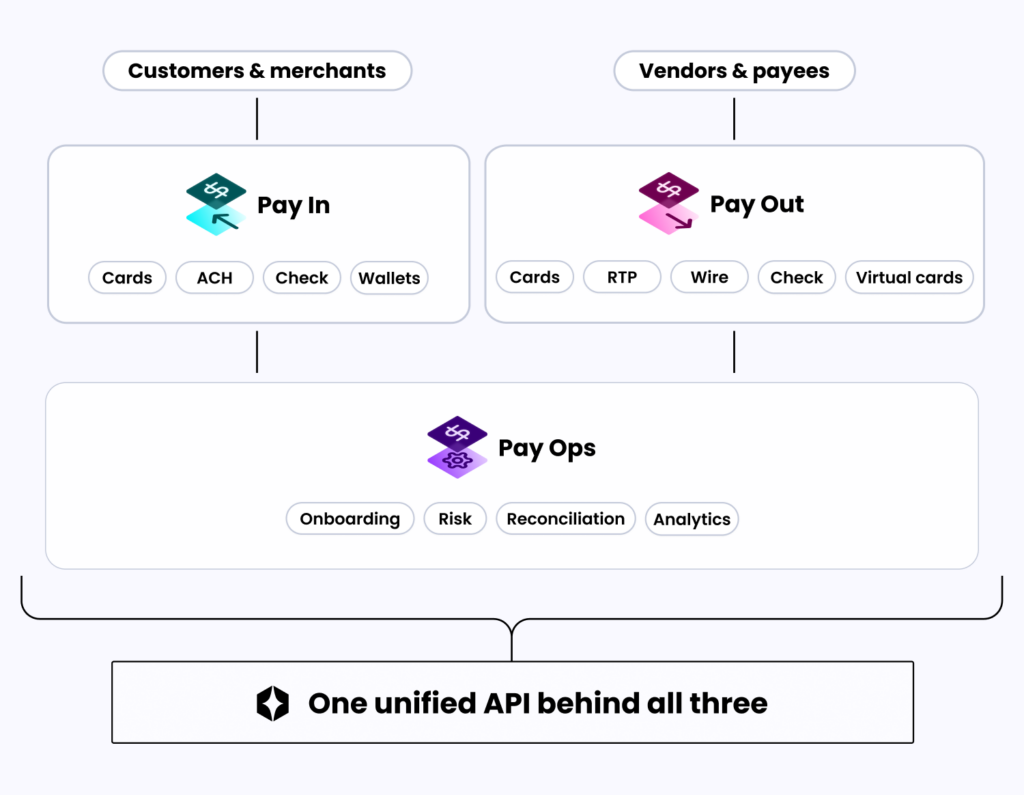
Payabli was purpose-built to solve this. We unify Pay In, Pay Out, and Pay Ops under a single infrastructure stack, giving SaaS platforms full ownership of the transaction lifecycle:

  • Pay In:  Accept payments seamlessly across cards, ACH, and alternative methods with optimized conversion and modern checkout experiences.
  • Pay Out: Automated, streamlined disbursements to vendors and suppliers via virtual cards, ACH, and checks.
  • Pay Ops: The back-office intelligence that ties it all together, from reconciliation to reporting to compliance.

This unified approach doesn’t just simplify operations. It fundamentally changes your platform’s economics by letting you capture—and keep—margin on both sides of every transaction.

The SaaS Platforms That Will Win Tomorrow Are Monetizing Vendor Payments Today

The future of SaaS isn’t about building better workflow tools. It’s about becoming essential financial infrastructure. The platforms winning tomorrow won’t just help their users work—they’ll control how money moves through their entire ecosystem.

Vendor payments are how you make that shift.

When you own payouts, you’re not just adding a feature. You’re fundamentally changing your relationship with customers. You become the platform they can’t leave – because leaving means rebuilding their entire financial operation. That’s not stickiness. That’s gravity.

The question isn’t whether to own this opportunity. It’s whether you’ll act before your competitors do.

Ready To Turn Payouts Into Profit?

With Payabli, SaaS platforms finally have the infrastructure to monetize both sides of the transaction journey – turning what was once back-office plumbing into a powerful engine for growth. Book a demo today to learn how Payabli can help you capture the vendor payment opportunity before your competitors do.

Pay by SMS: The Easiest Way for Vertical SaaS Platforms to Boost Payments Revenue

In today’s competitive vertical SaaS landscape, platforms need more than just great features to win and keep customers — they need revenue-generating capabilities that create measurable impact. Pay by SMS is one of the fastest, most effective ways to do just that.

With Pay by SMS, merchants can send secure payment links directly to their customers’ phones via text message. Customers tap the link, review their invoice, and pay instantly — no logins, no apps, no unnecessary steps.

And for SaaS platforms, every fast, seamless payment means more processed volume — and more revenue.

Why Pay by SMS Is a Game-Changer for SaaS Platforms

1. Accelerate Payment Volume
When merchants get paid faster and more often, your platform processes more transactions. More transactions mean more revenue opportunities from payment processing.

2. Differentiate Your Platform
Pay by SMS adds a high-impact, mobile-first payment option that many embedded payment providers don’t offer. It’s an instant value-add for merchants who want to meet their customers where they are — on their phones.

3. Boost Merchant Retention
Merchants stick with solutions that help them get paid faster. Offering Pay by SMS gives them a reason to process payments through your platform instead of exploring alternative payment processors.

4. Simple, Flexible Deployment
Pay by SMS can be enabled quickly through Payabli’s API or embedded directly into your existing invoicing flow for minimal development effort and maximum revenue impact.

How Pay by SMS Works

  1. Send Payment Link – Merchants generate and send a secure payment link for an invoice via API or your platform’s UI.
  2. Customer Opt-In – If customers are opted in, they receive the SMS instantly. If not, Payabli automatically sends an email prompting them to enroll.
  3. Receive & Pay – Customers tap the link, review the invoice, and pay in seconds.

Value for Merchants, Revenue for You

When your merchants thrive, your platform grows. By connecting merchants and customers through Pay by SMS, you’re giving them a faster, simpler way to complete transactions — and creating more opportunities for your platform to process payments.

Benefits for your merchants:

  • Get paid faster by sending invoices directly to a customer’s phone.
  • Avoid additional logins or apps and pay instantly with a text.
  • Enhance customer experience with a fast, seamless, and secure checkout.
  • Save time by automating payment requests and opt-in workflows.

Benefits for your SaaS platform:

  • Increase payment volume to generate more processing revenue.
  • Differentiate your platform with a high-impact payment option other embedded payment solution providers may not offer.
  • Boost merchant retention by delivering tools that directly improve cash flow.
  • Deploy with ease through Payabli’s developer-friendly API or by embedding into your existing invoicing flow.

Why Partner with Payabli for Pay by SMS

Payabli is built for embedded payments, making it simple for vertical SaaS platforms to bring Pay by SMS to market quickly and securely. Our API-first architecture allows seamless integration into your existing workflows, while our compliance-first approach ensures every transaction is fully protected. The result is a frictionless deployment that delivers immediate impact.

When you partner with Payabli, you’re not just enabling another way to pay — you’re unlocking a powerful revenue engine. Value-added features like Pay by SMS helps merchants collect payments faster, driving higher transaction volume, increased processing revenue, and stronger loyalty to your platform. With Payabli, you get a partner dedicated to helping your platform grow through seamless, revenue-driving payments.

Ready to see Pay by SMS in action?

Let’s talk about bringing Pay by SMS to your SaaS platform and unlocking new revenue streams.

The Silent Shift: How AI Is Transforming Embedded Payments

“We won’t see a singular moment where AI ‘takes over.’ It’s already happening—gradually, silently—and by the time we realize it, it’ll be everywhere.”
Johnny Mejias, Head of Engineering at Payabli


The Invisible Transformation

While headlines debate whether AI will revolutionize finance, SaaS platforms are already experiencing the quiet reality: it already has. Every time your users receive payment suggestions during onboarding, invisible AI is working in the background. This includes blocking fraud attempts and automatically handling overnight reconciliation. It protects your platform’s reputation and lowers your support burden.

The most profound technological shifts don’t announce themselves loudly. They embed themselves so seamlessly into your platform that you only notice their absence. In embedded payments, this invisible transformation is reshaping how SaaS platforms monetize and serve their customers in ways that drive both revenue and retention.

Common Misconceptions About AI in Fintech

AI is transforming embedded payments, but the conversation is often clouded by myths and misunderstandings. Let’s break down the most common misconceptions and explore the real potential of AI in payments:

Misconception #1: AI in embedded payments is just about chatbots and customer-facing features.

“People often frame AI in payments only through the lens of payers and merchants. But the bigger opportunity is how it protects and optimizes the relationship between businesses themselves.”  — Johnny Mejias, Head of Engineering at Payabli

The reality is far more sophisticated. Customer-facing AI gets a lot of attention. However, the real change happens at the platform level. Here, invisible AI improves your operational intelligence, strengthens compliance monitoring, and optimizes resource use.

Consider how AI enables your payment infrastructure to automatically detect unusual transaction volume spikes across your merchant base, predict which integrations might fail based on historical patterns, and dynamically allocate processing resources before your users experience bottlenecks. 

Instead of hiring additional analysts to monitor thousands of transactions manually, AI systems can flag anomalies, prioritize support tickets by urgency, and even suggest resolution paths. This changes your support model from reacting to problems to improving the platform before issues arise.

Misconception #2: AI must be visible to be valuable.

“AI is quietly reshaping payments behind the scenes—automating risk checks, streamlining onboarding, and reducing fraud—all without anyone needing to click a button.” — Reilly Catrambone, Software Engineer at Payabli

The most effective AI implementations in payments are the ones your users never interact with directly. Consider address auto-completion during merchant onboarding. When your users start typing “123 Main St” and your platform instantly suggests the full address with zip code – that’s AI working invisibly. 

Your merchants experience faster onboarding and reduced friction, but the machine learning models powering that suggestion engine remain completely hidden, seamlessly integrated into your existing UX.

At Payabli, we take the same approach internally. Tools like Amigo, our chat-based AI assistant, work behind the scenes to help our internal teams gather insights, simplify workflows, and speed up response times. This layer of invisible AI is made to help humans, not replace them. It shows that some of the best innovations are the ones you cannot see.

Misconception #3: All AI payment solutions are created equal.

“Our advantage is in the depth of our data. We don’t just have transaction volume—we understand vertical nuance. That’s what lets our models make smarter, context-aware decisions.” — Alex Finan, AI Engineer at Payabli

Many SaaS platforms think that AI features are the same. They believe one machine learning model is just as good as another. The reality is that AI is only as intelligent as the data it learns from and not all payment providers have the same quality of training data.

While the broader payments industry races to implement AI features, at Payabli we focus on depth over breadth to leverage unique data advantages to build more intelligent, context-aware systems that understand your specific vertical needs. 

This vertical-specific intelligence means our AI doesn’t just process your transactions – it understands the business context behind them. Where generic payment processors see transaction volume, we see the relationships, workflows, and patterns unique to your industry, enabling more accurate risk assessment and better user experiences for your specific customer base.

The Vertical Intelligence Advantage

While many providers rely on one-size-fits-all AI models, the real impact comes from context-aware intelligence tuned to the realities of each vertical. SaaS platforms don’t operate in generic payment flows. What looks normal in field services might appear risky in healthcare, and vice versa.

Real-World Applications Across Verticals:

  • Healthcare SaaS: Detect subtle anomalies in patient billing cycles, reduce false declines on recurring reimbursements, and enforce compliance checks without friction.
  • Field Services SaaS: Predict seasonal payment spikes, optimize mobile transactions, and prevent fraud tied to technician misuse.
  • Education Platforms: Align AI to academic calendars for recurring tuition payments, minimizing payment failures and reducing disputes.
  • HOA & Property Management: Forecast cash flow gaps, identify at-risk homeowners before they miss payments, and trigger proactive reminders to maintain financial stability.

Platforms that pair data depth with vertical nuance will lead the way in embedded payments. At Payabli, this focus shapes how we apply AI to fraud prevention, reconciliation, and revenue optimization – helping platforms deliver smarter, more resilient payment experiences.

What’s Next: AI Capabilities That Will Redefine Embedded Payments

Looking ahead, several AI capabilities are poised to fundamentally reshape how embedded payments work:

1. Automated Operations and Reconciliation

“AI is going to change the game when it comes to reconciling payments with bank flows. We’re talking about full automation of operations that used to require the work of entire teams.” — Johnny Mejias, Head of Engineering at Payabli

Traditional reconciliation requires manual review of transaction records against bank statements—a process prone to delays and errors. AI-powered systems can automatically match payments, identify discrepancies, and resolve most issues without human intervention. This isn’t just about efficiency; it’s about enabling real-time financial accuracy at scale.

2. Intelligent Risk Management & Fraud Agents

The next evolution in AI fraud detection goes beyond pattern recognition to proactive risk orchestration. AI agents will analyze transaction characteristics, merchant behavior, and external signals to make risk decisions in milliseconds. Whereas today, these decisions need skilled analysts and hours of work. By analyzing millions of transactions, these systems learn what “normal” looks like across different verticals, enabling instant response to anomalies.

At Payabli, we’re already implementing this vision through our advanced Fraud Risk Engine, which combines rule-based controls with machine learning models for both supervised fraud detection and unsupervised anomaly detection. The system automatically enforces dynamic transaction limits, velocity checks, and risk parameters while learning from each interaction to improve accuracy. 

What makes this powerful for SaaS platforms is the ability to customize AI fraud detection. This can be done for each partner or industry. It ensures that your platform’s unique risks are understood and protected without causing problems for real transactions.

3. Self-Service User Empowerment

“In five years, embedded payments won’t just be about moving money. It’ll be about giving merchants self-serve tools powered by AI to grow on their own.”
Ankita Chowdhry, AI Product Lead at Payabli

The future of embedded payments extends beyond transaction processing to business intelligence and growth enablement for SaaS platforms. AI will provide your platform with insights about payment patterns across your user base, optimization recommendations for improving conversion rates, and automated tools that help both you and your merchants improve cash flow and customer experience without additional development resources.

Join the Conversation

The AI transformation in embedded payments is far from complete. As AI technologies mature and new capabilities emerge, the most successful platforms will be those that prioritize thoughtful implementation over flashy features.What’s the biggest AI shift you see coming in payments? Tag us @Payabli to join the conversation and shape the future of intelligent payment infrastructure.

Curious how it’s already transforming the industry? Book a demo to see AI-powered payments in action.

Integrated vs. Embedded Payments: What’s Best for Your Vertical SaaS?

In the ever-evolving world of vertical SaaS platforms, choosing the right payment strategy can be a make-or-break decision—not just for platform growth, but also for customer experience and monetization. Two terms often used in this conversation are integrated payments and embedded payments. While they may sound similar, the difference is profound—and so are the benefits of getting it right.

In this post, we’ll break down the distinction between integrated and embedded payments, and explain why embedded payments are the gold standard for vertical SaaS platforms looking to scale efficiently and profitably.

What Are Integrated Payments?

Integrated payments refer to the approach where a SaaS platform connects to a third-party payment provider (such as Stripe, PayPal, or Authorize.Net) using APIs or plug-ins. While the integration enables payment functionality, the actual experience—like merchant onboarding, transaction monitoring, or settlement—is still handled largely outside of your platform.

Characteristics:

  • Merchants often sign up with the third-party provider directly.
  • Users may be redirected outside the platform for onboarding or dashboards.
  • The SaaS company has limited control over the user experience and monetization.

What Are Embedded Payments?

Embedded payments go a step further by deeply integrating the entire payment experience within the SaaS platform. From merchant onboarding and KYC, to accepting payments, managing payouts, and delivering insights—everything happens natively in the software interface.

Fully embedded payments within your platform mean that merchants onboard, transact, and access real-time reporting without ever leaving your software. This ensures a seamless, consistent experience that feels like a natural part of your product—not an external add-on.

This model is often powered by becoming a Payment Facilitator (PayFac) or by partnering with a PayFac-as-a-Service provider.

Characteristics:

  • Seamless, native onboarding and UI
  • Full control over branding and experience
  • Monetization opportunities through payment revenue
  • The platform owns the merchant relationship

Why Embedded Payments Win on User Experience

For vertical SaaS platforms, user experience is everything. Embedded payments dramatically enhance the merchant journey and unlock new business value in ways integrated payments simply can’t.

1. Frictionless Onboarding

Say goodbye to third-party forms and redirection. Merchants can sign up and start accepting payments right inside your platform—often within minutes.

2. Unified UI and Experience

The payment flow stays consistent with your platform’s design. This creates a branded, trustworthy experience for your users.

3. Faster Time-to-Revenue

While integrated options may involve multi-day approval processes, embedded payments often enable instant and/or bulk onboarding and activation—meaning your users start transacting sooner.

4. Deeper Data Visibility

With embedded payments, your platform owns the entire data flow—transaction history, user behavior, payout activity—which means better analytics and smarter customer engagement.

5. New Revenue Streams

Rather than handing over valuable payment margins to third parties, you capture a share of the transaction revenue. This high-margin income can transform your SaaS business model.

6. Streamlined Compliance (with the Right Partner)

PayFac-as-a-Service solutions help you deliver a native experience without taking on the full regulatory or administrative burden of being a registered PayFac yourself.

What to Look For in an Embedded Payments Provider

If you’re ready to embed payments into your SaaS platform, the provider you choose will have a massive impact on both your product experience and your bottom line. 

Here are four key things to look for:

1. Unified Pay-In and Pay-Out Capabilities

A common limitation among many embedded payment providers is the inability to support both pay-ins and pay-outs under one roof. This can create friction when trying to manage sub-merchants, service providers, or vendor payouts. Choose a provider that bridges both sides of the money movement—ensuring faster settlement, seamless fund distribution, and better cash flow control.

2. Flexible Integration Options

Your development team shouldn’t have to force-fit your platform into rigid SDKs or templated flows. Look for providers that offer:

  • Modern, modular APIs
  • Webhooks and event-driven architecture
  • Clear documentation and sandbox environments

This allows you to tailor the payment experience to your platform’s design and business logic.

3. Hands-On, Expert Support

Payments can be complex—but your journey shouldn’t be. The right provider offers proactive, strategic guidance from discovery to go-live, and everything in between. That includes:

  • Technical integration support
  • Merchant onboarding optimization
  • Compliance and risk workflows
  • Ongoing product and go-to-market strategy

Beyond launch, you should expect responsive, hands-on support from experts who understand your industry. The right partner will help you and your customers resolve issues quickly, optimize operations, and provide guidance tailored to your vertical—whether you’re serving contractors, gyms, law firms, or property managers. 

This kind of support reduces risk, accelerates go-live, and builds long-term confidence in your payment infrastructure.

4. Cost and Pricing Transparency

A strong payments partner doesn’t just present pricing—they help you understand it and turn it into a strategic revenue stream. Look for:

  • Transparent rates and no hidden fees
    Your partner should clearly explain interchange and processing costs, what’s being charged, and why—so there are no surprises.
  • Flexible monetization options
    Whether you absorb fees, pass them on, or bundle them into your pricing, you should have control over how payments contribute to your bottom line.
  • Simple, easy-to-read billing
    Avoid confusing or opaque statements. Clear, itemized billing builds trust and streamlines reconciliation.
  • Tailored pricing strategies by vertical
    The right provider helps you set pricing that fits your market—allowing you to control margins, define terms, and capture revenue in ways that align with how your customers buy, whether you’re serving contractors, law firms, fitness studios, or beyond.

For vertical SaaS platforms, payments are more than a back-end utility—they’re a strategic lever for growth, retention, and monetization. While integrated payments may offer a quick start, embedded payments create long-term value through a smoother user experience, stronger brand ownership, and deeper monetization opportunities.

Choosing the right partner is just as important as choosing the right model. With the right embedded payments provider, your SaaS platform won’t just process payments—it will own them.


Want to learn more about embedding payments in your vertical SaaS platform? Let’s talk – we’d love to help you unlock the next layer of growth.