Key takeaways
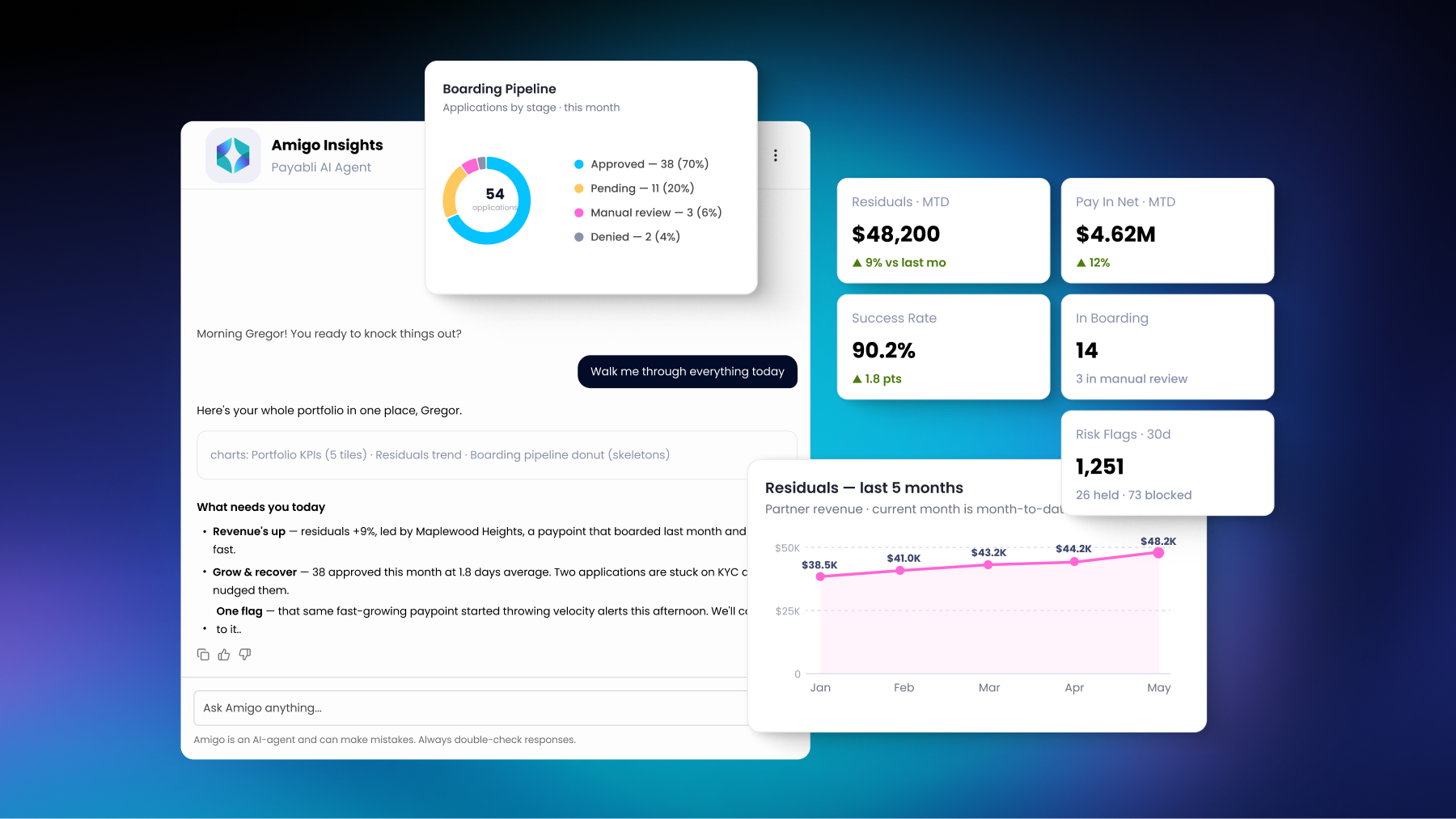
- Amigo Insights is a conversational AI analytics agent inside the Payabli Portal. Your operations, finance, risk, and growth teams ask questions about live payments data in plain English and get answers instantly.
- It is read-only and works in real time: answers reflect your live data, it never modifies transactions or touches your production database, and sensitive personal information is never surfaced.
- It spans your whole payments business, from Pay In and Pay Out to merchant activity, chargebacks, and onboarding, and complements your existing reports instead of replacing them.
- It is pre-built and ready on day one, so your team gets answers without standing up a data warehouse, custom dashboards, or new headcount.
Every transaction, disbursement, and merchant interaction on your platform generates valuable intelligence. The problem isn’t a lack of data, it’s access to it. With most payment providers, getting an answer usually means waiting on a data team, pulling a manual export, or filing a support ticket. By the time the number lands in your inbox, the moment to act on it has often passed.
Today, that changes. We’re excited to introduce Amigo Insights, an AI-powered analytics agent embedded directly in the Payabli Portal that gives your platform teams instant, natural-language answers across your live payments data. No dashboards to build. No exports to wrangle. No analyst required. Just ask, and get an answer.
What is Amigo Insights?
Amigo Insights is a conversational business intelligence layer for your payments data. Think of it as a direct line to everything happening across your Pay In, Pay Out, and merchant activity, available to your entire team, the moment you need it.
It’s built exclusively for vertical SaaS platforms on Payabli, and it’s designed for the people who run your payments business day to day: operations, finance, merchant success, risk, and growth. Instead of routing routine data questions through support or waiting on a custom report, your team can simply ask a question in plain English and get an answer back instantly.
Static dashboards tell you what happened. Amigo Insights helps you understand what it means, and what to do next.
How does Amigo Insights work?
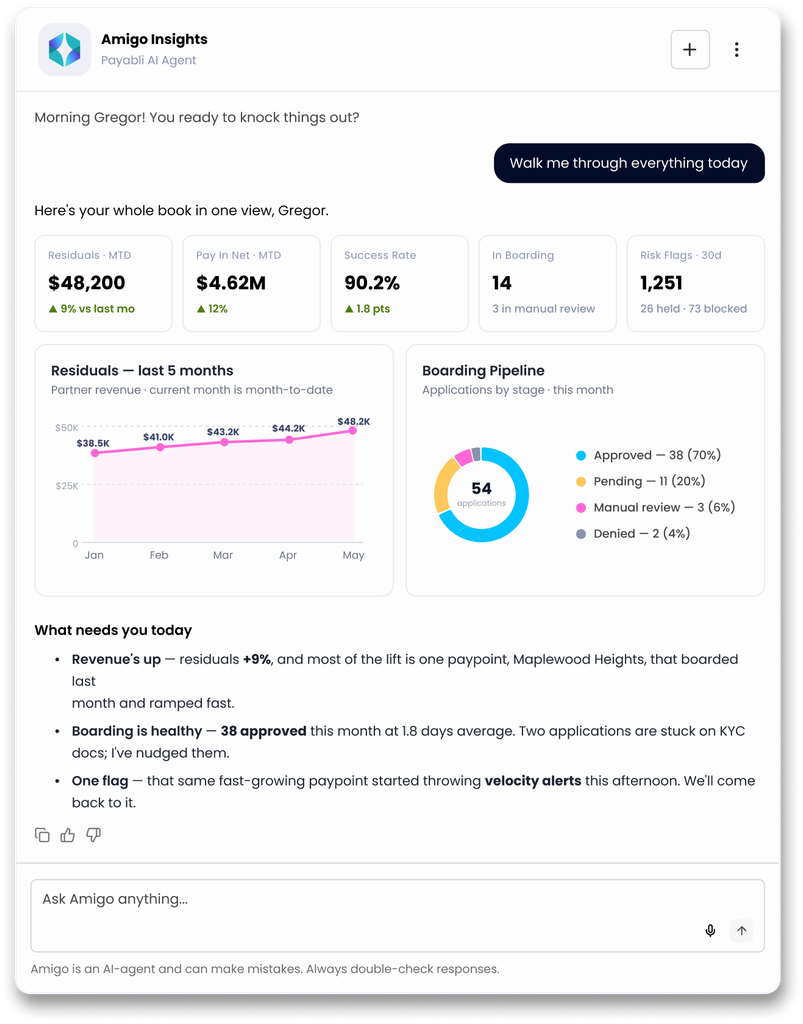
Amigo Insights lives right inside the Payabli Portal, so there’s nothing to build and nothing to code. It’s pre-built and ready to answer questions from the get-go.
Under the hood, it connects to your live payments data through a secure, read-only connection and queries that data in real time. The answers it returns reflect exactly what’s in your system right now, not a cached snapshot or a delayed export. Ask a question through the conversational interface, and Amigo Insights responds on the spot.
A few things worth knowing about how it thinks:
- It’s accurate by design. Amigo Insights pulls directly from your live data, so the numbers it returns are the numbers in your system.
- It asks before it assumes. When a question is ambiguous, Amigo Insights asks a clarifying question rather than guessing. Accuracy is prioritized over speed.
- It’s read-only. Amigo Insights surfaces and analyzes your data, it never touches your production database and can’t initiate or modify transactions.
What can you ask Amigo Insights?
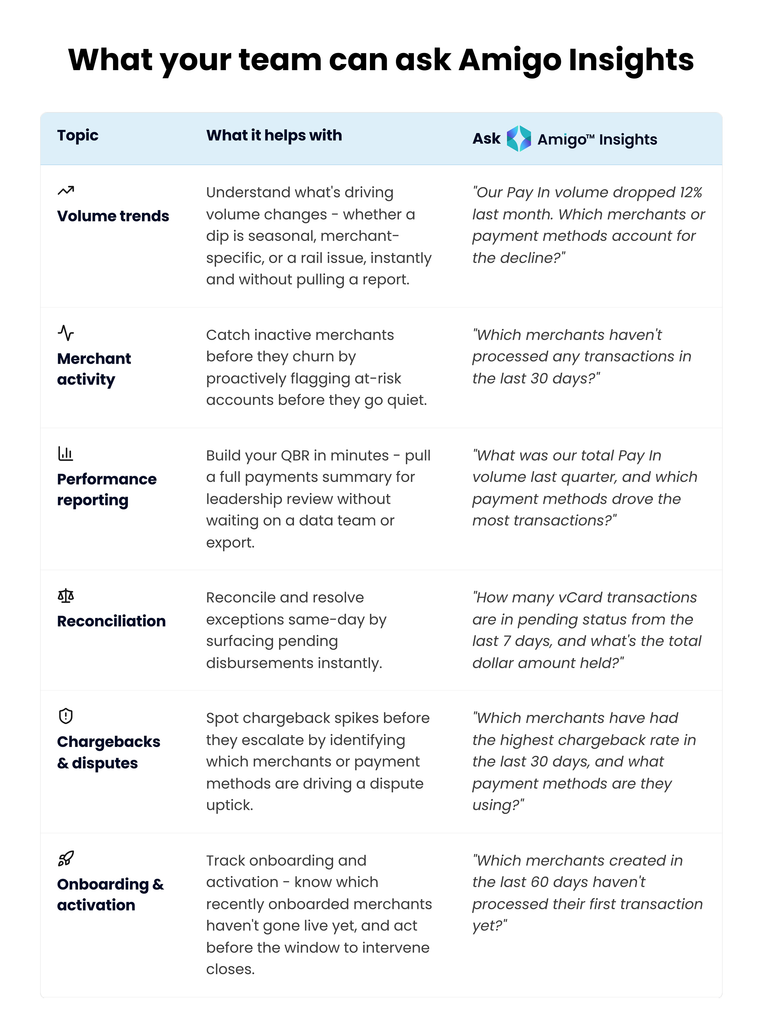
Amigo Insights works across your full payments business, payment acceptance, accounts payable to vendors, volume trends, merchant activity, chargeback data, onboarding status, and payment method performance. It can even answer Payabli product and documentation questions, from supported rails to API references.
A few examples of what your team can ask on day one:
What sets Amigo Insights apart
What separates Amigo Insights from bolting a chatbot onto your reporting comes down to three things: the capability itself, how little you have to build to get it, and how tightly your data stays controlled.
First-mover advantage
Merchant-facing, conversational AI analytics has, until now, existed only at the largest enterprise-scale platforms, and even then, it’s typically aimed at individual sellers or gated behind SQL-based query tools. No embedded payments platform serving vertical SaaS has offered a pre-built AI analytics chatbot like this. Amigo Insights gives your platform a capability that was previously reserved for the top tier of the market.
Business intelligence without the build
Most platforms don’t have the time or the dedicated analysts to stand up their own business intelligence layer across payments data. Amigo Insights is pre-built and ready to answer questions immediately.
Enterprise-grade security
Built with the same data protections as the rest of the Payabli platform, Amigo Insights is scoped exclusively to your organization. Sensitive personal information (bank account numbers, routing numbers, SSNs, EINs, card details) is never surfaced, and because it’s read-only, it can analyze your data but never alter it.
Why it matters
The fastest-growing platforms aren’t doing more. They’re knowing more.
Every day your team can’t get to an answer quickly is a day a churn signal goes unnoticed, a chargeback trend goes unaddressed, or a QBR gets built the hard way. Amigo Insights collapses that gap. It turns the payments intelligence your platform already generates into fast, self-serve, actionable decisions, and it does it without adding a single line of code or a single new hire.
Amigo Insights is meant to complement your existing reporting. Your structured reports stay exactly where they are. Amigo Insights handles the ad-hoc, in-the-moment questions your team currently routes through support or pulls by hand, the ones that, until now, cost you time you didn’t have.
The Amigo AI agent suite
For years, AI-native payments intelligence was a luxury only the largest platforms could afford to build. Payabli’s Amigo AI agent suite closes that gap by building intelligence directly into Pay In, Pay Out, and Pay Ops, and bringing it to the vertical SaaS platforms that need it most.
Amigo Insights is the first of those capabilities to reach your team, turning live payments data into instant answers. It’s the beginning of a broader shift: a payments infrastructure platform that helps you recover revenue, manage risk, and cut manual work automatically, and that gets more capable with every release. Your platform doesn’t just get a new feature. It gets an AI layer that grows.
Getting started
Amigo Insights is available right now, directly within the Payabli Portal. There’s no setup, no integration work, and no support ticket required. Team members across your organization can log in and start asking questions today.
This is just the beginning. API-based integration into your own platform UI and expanded access for your merchants are already on the roadmap. But the on-demand payments analyst your team has been waiting for is here today.
Ready to see what your data can tell you? Log in to the Payabli Portal and ask Amigo Insights your first question, or book a demo to see it in action.