
Key takeaways:
- Without IVR payments, vertical SaaS platforms miss a major revenue channel. Payment-related calls can account for roughly half of inbound call volume in many businesses. Adding IVR captures those transactions, cuts merchant costs, and deepens platform stickiness.
- IVR payments let customers pay by phone through an automated system using their keypad or voice prompts, with no live agent required and 24/7 availability.
- Call trees are the branching logic that shape each caller’s experience. With Payabli, platforms can build their own, use white-glove design services, or launch from pre-built industry templates.
- Adding IVR alongside digital channels creates omnichannel payment coverage, which correlates with stronger merchant retention.
Most vertical SaaS platforms building embedded payments focus exclusively on digital channels like web, mobile, and payment links. But here’s what they’re missing: in many businesses, payment-related calls account for around 50% of inbound call center volume.
This represents a massive opportunity. Adding IVR payments lets you capture transaction volume competitors miss, reduce merchant operational costs, and create deeper platform integration that drives retention.
But what exactly are IVR payments? How do call trees guide the customer experience? And why do they create such powerful switching barriers for SaaS platforms chasing embedded payments revenue?
In this article, we explain what IVR payments are, how call trees guide the customer experience, and the strategic benefits for your platform.
What are IVR payments?
Interactive Voice Response (IVR) payments let customers make secure credit card and ACH payments over the phone using an automated system, with no live agent required. Customers call a secure phone number, follow voice prompts, or use their keypad to enter payment information, and receive instant confirmation.
Think of it as a virtual terminal that customers operate themselves through their phone, available 24/7/365. Because the caller enters card data directly via DTMF tones, no agent ever sees or hears the details, which helps platforms reduce their PCI DSS compliance scope.
The flow is simple:
- Customer calls the merchant’s payment line.
- The automated system prompts for payment details (amount, account number, card info).
- Customer enters information via keypad or voice prompt.
- Payment processes in real time.
- Customer receives instant confirmation.
The entire interaction runs through your SaaS platform’s payment infrastructure, with IVR calling your existing APIs to validate accounts and retrieve balances, and uses the same Payabli APIs, reporting dashboard, and compliance standards as your other payment channels.
How do IVR call trees work for vertical SaaS?
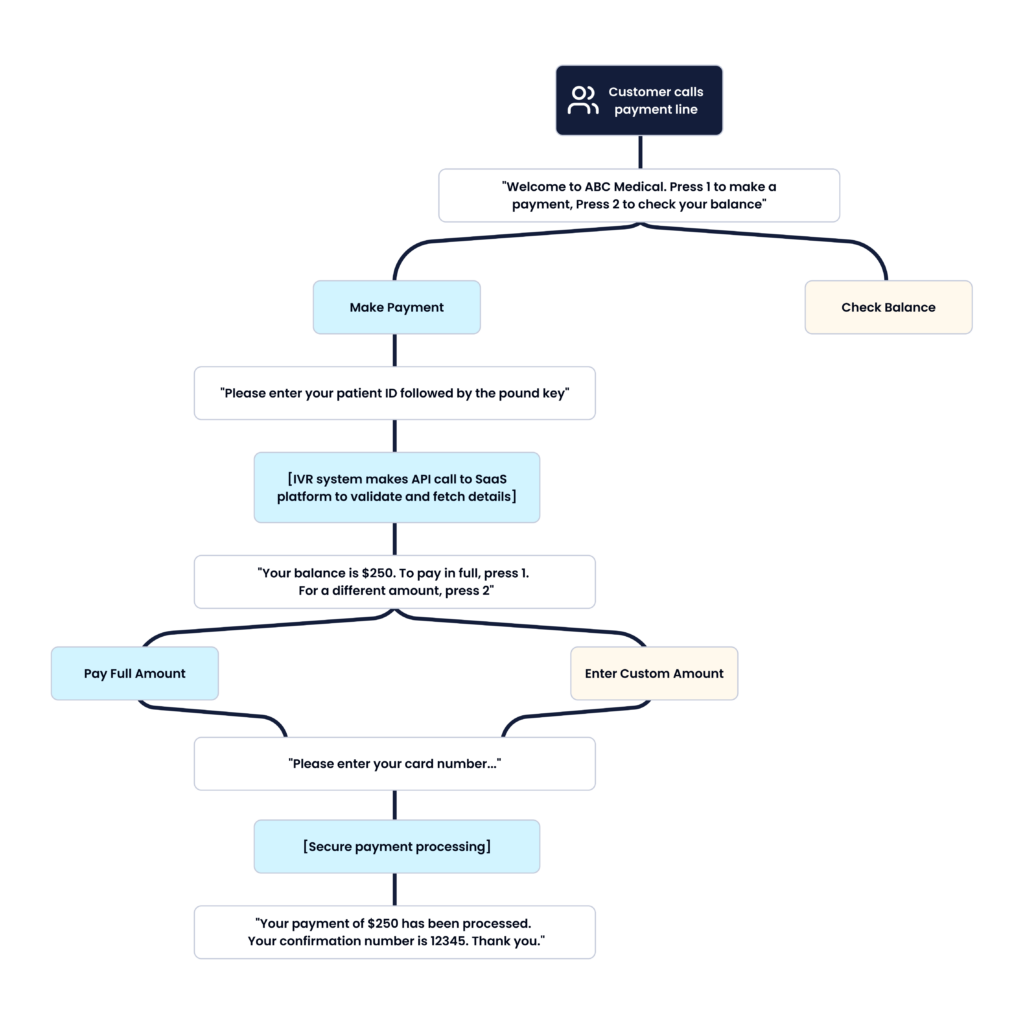
A call tree is the branching logic that guides customers through the IVR payment experience. It’s like a flowchart for phone interactions where each prompt leads to different paths based on what the customer selects.
IVR Call Tree Options
Call trees can be simple (straight to payment) or complex (account lookup, payment options, balance inquiries). The good news? With Payabli, you have options:
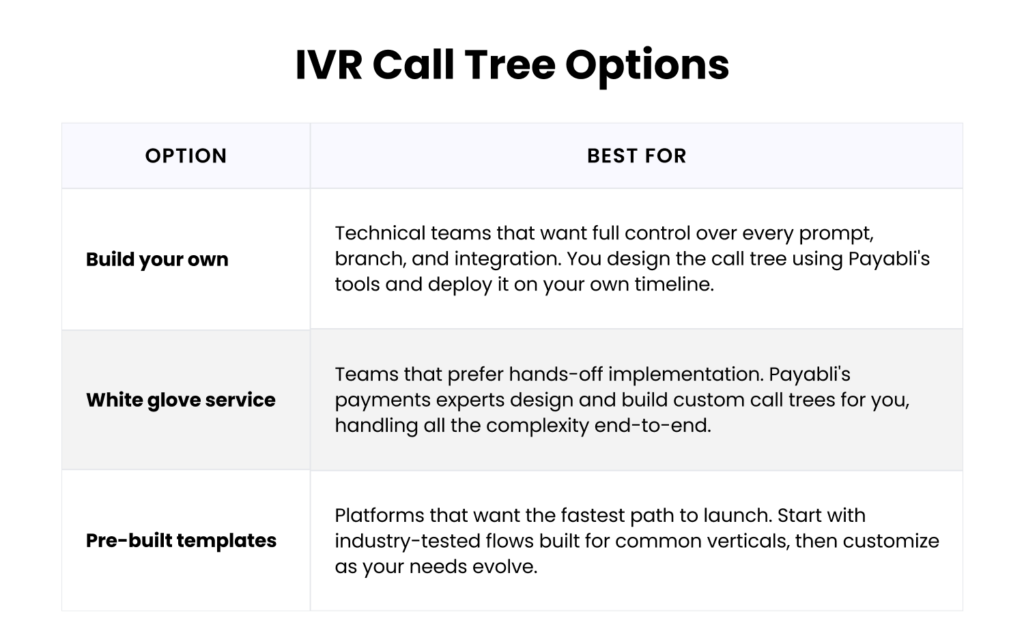
Whichever path fits, most platforms go live in weeks, not months. And for teams that want to skip code entirely, Payabli Creator handles it.
Example IVR call tree for a medical practice
The beauty of IVR call trees is their flexibility. They adapt to your merchants’ specific workflows, terminology, and customer needs. Here’s an example:
Why do IVR payments matter for vertical SaaS?
Adding IVR to your embedded payments offering is not just about giving merchants another channel. It drives measurable impact across revenue, retention, and operational efficiency.
1. Create a new revenue stream
IVR transactions generate higher margins than standard payment processing. You set the service fees (typically per transaction fee, monthly platform fee per phone number, or both) and capture that revenue directly.
These fees are easy to justify with immediate merchant ROI:
- Eliminate staff costs for manually processing phone payments
- Reduce support calls by 20-30%
- Provide 24/7 payment acceptance without adding headcount
- Accelerate collections and improve cash flow
2. Deploy quickly without engineering burden
IVR integrates through the same Payabli API as your other payment channels. No separate phone system builds, no phone provider registrations, and no ongoing maintenance teams. Payabli provides a complete, production-ready solution so you can focus on your core product.
3. Create switching barriers
Merchants using multiple payment channels through your platform are exponentially stickier. When you’ve automated their phone payments and integrated with their workflows through your software, switching costs skyrocket. Companies with strong omnichannel customer engagement strategies retain 89% of their customers on average, compared to 33% for companies with weak engagement.
4. Unlock high-value vertical use cases
Payabli’s configurable IVR integration enables powerful automation across need-to-pay verticals:
- Streamline invoice collection: Law firms let clients pay retainers and outstanding invoices immediately without waiting for mailed checks.
- On-time payments: Homeowners and renters can pay HOA dues or rent by phone from anywhere, making it easier to submit payment before the due date and avoid late fees.
- After-hours revenue: Field services can capture payment immediately when jobs finish outside business hours.
- Self-service payments: Healthcare practices and service businesses let customers pay invoices on their schedule without waiting on hold.
- 24/7 availability: Emergency services for urgent situations are available anytime without requiring staff.
Why vertical SaaS platforms choose Payabli for IVR payments
In competitive vertical SaaS markets, success means understanding your merchants’ complete operational reality. IVR payments are not legacy technology. They are incremental revenue, reduced churn, and platform differentiation rolled into one capability.
The vertical SaaS platforms dominating embedded payments are not the ones with the flashiest checkout. They are the ones comprehensively solving how money moves 24/7 across every channel. Payabli’s unified payment infrastructure covers payment acceptance, accounts payable, and payment operations, giving you everything you need to be that platform.
Want to add IVR payments to your platform? Book a demo and we’ll walk you through it.