Author: Marielle Mekkaoui

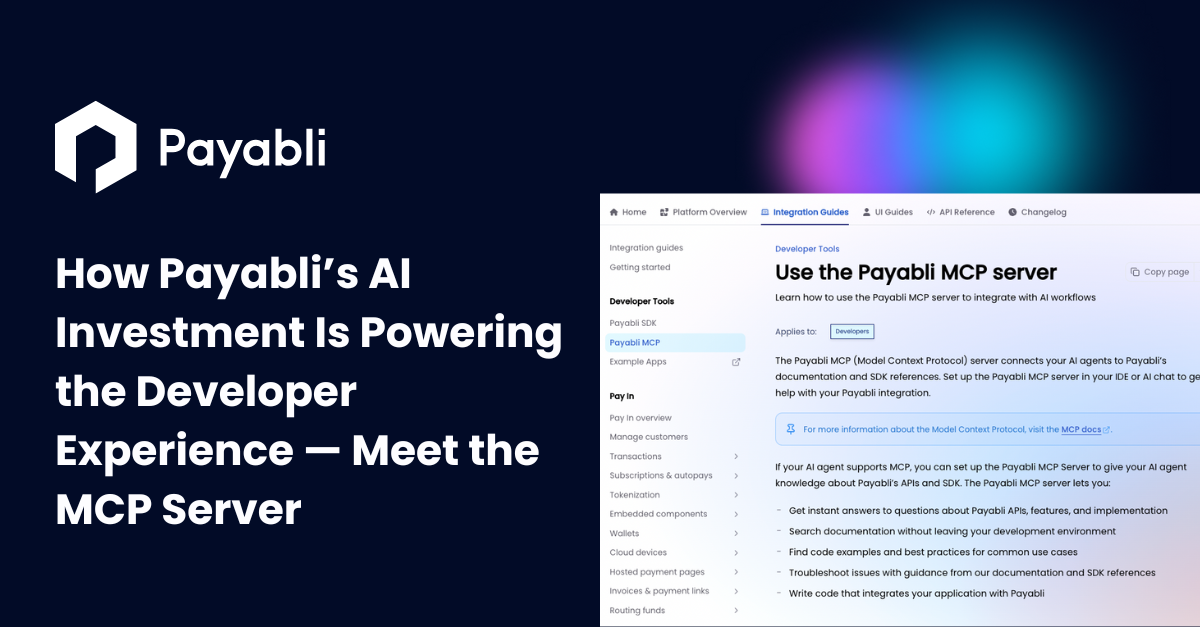
How Payabli’s AI Investment Is Powering the Developer Experience — Introducing the MCP Server and the Future of AI Payment Infrastructure

Your AI assistant’s payment expertise.

When we announced our $28M Series B funding, we shared our vision for the future of payments—one where AI plays a central role in how developers build and interact with payment infrastructure. Today, we’re bringing that vision to life with the launch of the Payabli MCP (Model Context Protocol) Server—the first of several AI-powered tools that mark the beginning of a new era in AI payment infrastructure and fundamentally change how developers integrate with our platform.

The Problem We Set Out to Solve

Every developer building with payments APIs faces the same frustrating workflow: code for a few minutes, switch to documentation, search for the right endpoint, copy code samples, switch back to the Integrated Development Environment (IDE), repeat. This constant context-switching kills productivity and slows down innovation.

We knew AI could solve this, but existing AI coding assistants lack the deep, real-time knowledge of payment systems that developers actually need. Generic responses don’t cut it when you’re handling sensitive financial data and complex compliance requirements.

AI Payment Infrastructure: Investment in Action

The Payabli MCP Server represents exactly the kind of AI innovation we promised investors and developers. Instead of building another chatbot or documentation search tool, we created something fundamentally different: a direct pathway between AI assistants and our live payment infrastructure.

We’re also early adopters of the Model Context Protocol (MCP) – an emerging standard for connecting AI assistants to external data sources. By staying ahead of this technology curve, we’re ensuring that developers on our platform get access to the most advanced, context-aware AI tools as they become available.

Here’s what makes it revolutionary:

  • Real-Time Documentation Sync: Your AI assistant accesses the same live API references in the Payabli Docs – no outdated examples or deprecated methods.
  • MCP-Powered Payment Intelligence: Your existing AI agents can leverage our MCP server to deliver precise, context-aware guidance about the Payabli API, including payment flows, compliance requirements, and more.
  • Zero Context Loss: Developers never leave their IDE. The AI brings Payabli expertise directly into their development environment.

What Developers Are Building

Early adopters are already using MCP to accelerate development across various industries:

  • Construction software platforms implementing contractor payment workflows
  • Educational technology companies setting up subscription billing for course platforms
  • Government software providers integrating secure payment processing for public services
  • HOA management platforms building automated dues collection systems
  • Field Services software processing mobile payments for service appointments

Why AI-Enabled Payment Infrastructure Matters for the Industry

In today’s fintech landscape, many companies are bolting on AI as an afterthought – typically in the form of customer service chatbots or surface-level analytics dashboards. But these limited implementations miss the bigger opportunity: rebuilding the developer experience from the ground up with AI at the core.

We’re pioneering a new category: AI-native payment infrastructure. Instead of simply making payments “AI-enabled,” we’re flipping the paradigm—making AI development payments-native. This approach deeply integrates payment capabilities into AI systems, opening up transformative possibilities for automation, personalization, and scale.

As early adopters of Model Context Protocol (MCP) – an emerging standard for connecting AI assistants to external data sources – we’re staying ahead of the curve. MCP ensures that developers working within our platform can seamlessly build intelligent, context-aware payment applications using the most advanced tools as they emerge.

By embracing these AI-first principles, we’re not just improving fintech infrastructure—we’re reshaping the future of how AI and payments work together.

The Developer Impact

What excites us most isn’t the technology – it’s what developers will build with it. When integration friction disappears, innovation accelerates. We’re already seeing:

  • Faster time-to-market for payment features
  • Reduced errors with AI-guided implementation
  • Higher quality integrations with built-in best practices
  • More experimentation with advanced payment capabilities
  • Reduced technical debt from cleaner, AI-guided implementations

Getting Started

Already using Payabli? Try the MCP Server and start building with AI-powered integrations today.

New to Payabli? Book a demo to see our embedded payment infrastructure and AI-powered developer tools.

This is just the beginning of AI-powered development at Payabli. Stay tuned as we continue rolling out more AI-powered tools.
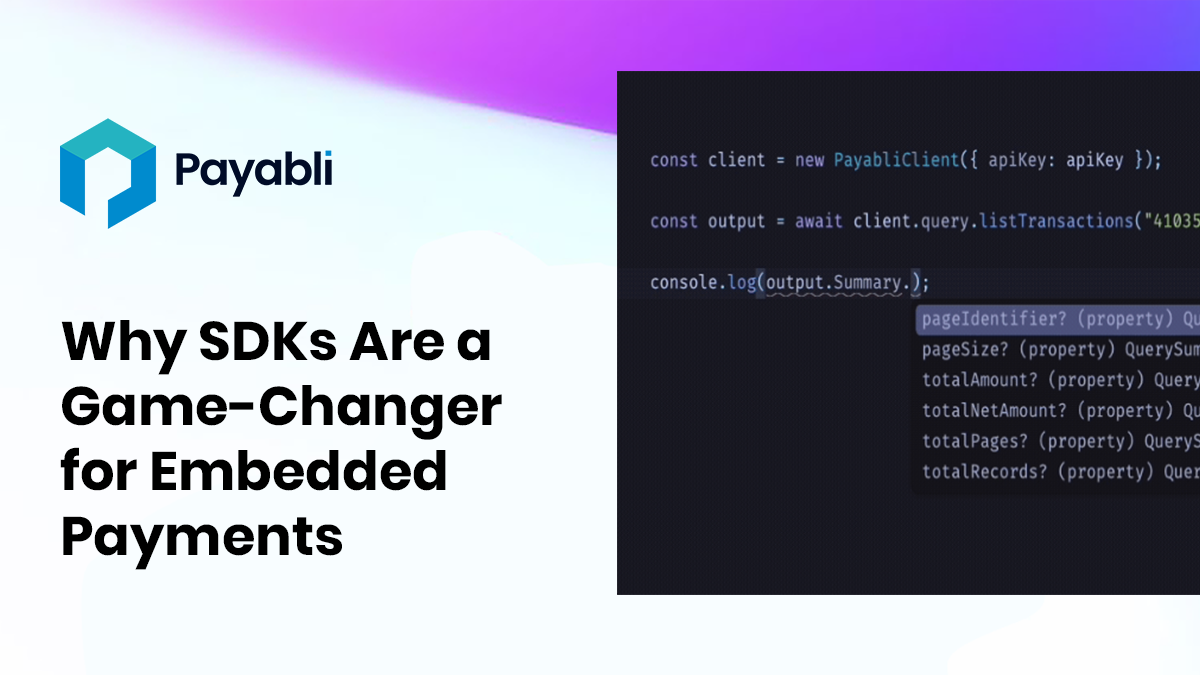
Why SDKs Are a Game-Changer for Embedded Payments

Building payment infrastructure is hard. Integrating it into your SaaS platform shouldn’t be.That’s why we built the Payabli Software Developer Kit (SDK) for C#, Go, Java, PHP, Python, TypeScript and Ruby – a tool that gives developers everything they need to build embedded payment solutions quickly, reliably, and without the typical headaches of custom integrations. Whether you’re launching new features or scaling your platform, the right SDK isn’t just a convenience – it’s a competitive advantage.

The Problem: Payment Integration Slows Teams Down

Let’s face it: developers have better things to do than wrangle complex APIs, debug authentication flows, or troubleshoot errors after production. Payment integration, while essential, can often drain business resources. It takes time, introduces risk, and pulls engineers away from core product work.

This becomes even more painful as your company scales. Custom-built integrations tend to break, APIs change, and the surface area for bugs only grows.

The Payabli SDK Solution: Build Once, Launch Fast

A well-designed SDK changes the game. Instead of spending weeks building and testing a payment flow, developers can compose straightforward methods and go live in hours. The SDK takes care of the heavy lifting, so your team can focus on building the features that move your product forward.
Check out how our Payabli SDK improves both speed and developer experience:

  • Accelerate Development
    Quickly embed authentication, payment initiation, and API calls with just a few lines of code so you can get up and running faster.
  • Catch Issues Early
    Includes built-in error handling and retry logic that automatically flags issues before production – saving time and ensuring smoother launches.
  • Works With Your Tech Stack
    Designed for modern back-ends across C#, Go, Java, PHP, Python, and TypeScript – no rewrites or awkward workarounds
  • Build Fast from Sandbox to Production
    Production-ready in hours instead of weeks building a custom API integration, so you can launch confidently without rewriting your payment logic later. 

Why It Matters

An SDK is more than just a shortcut. It’s a developer quality-of-life upgrade.

By simplifying the most repetitive, error-prone parts of building embedded payment solutions, the Payabli SDK gives developers confidence and control. It reduces mental overhead, cuts down on bugs, and lets your team focus on building what actually moves the needle for your business.

In short, it makes shipping payments feel as seamless as any other modern developer task – which is exactly how it should be.

Who It’s For

We designed this SDK for high-growth SaaS and ISV platforms looking to embed and monetize payments. Whether you’re just starting out or scaling across verticals, the Payabli SDK is built to support you every step of the way – in whatever language your team works in.

If developer velocity is key to your success (and let’s be honest – when is it not?), then this is the tool you’ve been waiting for.

Ready to Build Smarter?

Our SDK is fully self-serve and ready for you to explore. Just head to the Payabli Developer Docs to start building embedded payment solutions. 

Interested in helping us make the best developer experience in payments? If you have ideas, questions, or want to be part of upcoming user research, we’d love to hear from you at docs@payabli.com

Remote Deposit Capture for SaaS: Modernize Check Payments

While digital payments like cards and ACH are on the rise, many businesses across industries still rely heavily on checks. Paper checks remain a common payment method across SaaS verticals like field services, property management, legal, and healthcare—yet most platforms lack the tools to manage check deposits digitally. That’s where remote deposit capture comes in: it enables businesses to scan and deposit checks electronically, streamlining a historically manual process and helping platforms modernize check acceptance alongside digital payments.

Payabli’s Remote Deposit Capture (RDC) solves this problem by embedding check scanning and depositing directly into your software platform. With RDC, your merchants can capture and deposit checks without leaving your application—improving cash flow, reducing errors, and consolidating all payment data in one place.

What Is Remote Deposit Capture?

Remote Deposit Capture is a technology that enables users to scan and deposit checks digitally using a mobile device, desktop scanner, or tablet. Instead of physically visiting a bank or relying on manual uploads, RDC streamlines the check deposit process and allows deposits to be initiated from within your software.

With Payabli’s RDC, platforms can embed this capability into their existing UI, giving merchants a faster, simpler way to manage check payments while keeping all transactions—cards, ACH, and checks—within a single system.

Benefits of Remote Deposit Capture with Payabli

Faster Deposits
Cut time-to-cash by more than 60%. Checks that once took up to 8 days to clear can now be deposited and processed in just 2–3 days.

Embedded Check Capture
Offer a seamless user experience with white-labeled check scanning built directly into your software. Merchants can capture and deposit checks using their mobile phone, desktop, or tablet.

Image Validation & Quality Assurance
Payabli’s RDC technology ensures a ~97% image acceptance rate, minimizing errors and rejected deposits through automated image validation.

Streamlined Reconciliation
Eliminate fragmented systems. Consolidate all payment data—card, ACH, and checks—into a single platform for improved financial visibility and simplified reporting.

Developer-Friendly Integration
Go live in days, not weeks. Our clean APIs, robust documentation, and pre-built UIs make it easy to embed RDC into your platform.

Flexible Monetization
Monetize RDC by marking up ACH service fees or joining our revenue share program. Control your margins and unlock new revenue streams.

Ideal Use Cases and SaaS Verticals for Remote Deposit Capture

Payabli’s Remote Deposit Capture is ideal for B2B SaaS platforms that support industries with high check volumes and field-based operations, including:

  • Field Services and Construction
  • Property Management and HOAs
  • Legal and Professional Services
  • Healthcare
  • Nonprofit

Additional Capabilities

  • White-Labeled Experience: Match your brand with customizable UI for check capture.
  • On-Site Image Capture: Enable users to scan checks instantly from their location.
  • Upcoming X9 Support: Soon support high-value business checks above $25,000 with X9 file integration.

Why Remote Deposit Capture Matters

Many SaaS platforms already use Payabli to manage card and ACH payments. However, checks are often handled outside the platform, requiring manual deposits and creating reconciliation challenges. This disconnect leads to operational inefficiencies, slower cash flow, and increased errors.

By embedding Remote Deposit Capture, your platform becomes the single destination for all payment types—delivering a better experience for merchants and giving you a competitive edge.

Get Started Today

Ready to embed Remote Deposit Capture into your platform and modernize check collection for your users? Contact our team today to get started — or explore our developer docs to see how easy integration can be.

Why KYC and KYB Matter for SaaS Platforms Embedding Payments

What is KYC and KYB?

KYC (Know Your Customer) and KYB (Know Your Business) are regulatory and compliance processes that SaaS platforms—especially those offering embedded payments or financial services—must follow to verify the identities of their users or the businesses using their platform.

Why KYC and KYB Are Required for Sub-Merchants Using Embedded Payments

When your customers begin the onboarding process to accept payments through your SaaS platform, it’s not uncommon for some merchants to pause at the merchant application.  “Why do you need my Social Security Number? My business address? Why all this information?”

This is a common question from businesses new to embedded payments. What many do not realize is that opening a merchant account is a form of credit. Just like applying for a working capital loan, processors and financial partners must verify who they are working with to manage risk and protect the payment ecosystem. Ironically, most businesses provide even more data for a loan without question.

If they are willing to provide this information to borrow money, they should feel just as confident doing so to get paid.

1. KYC and KYB Are Required for Payment Compliance

Embedding payments means operating within a regulated financial ecosystem. Payment processors, sponsor banks, and card networks are required to follow strict anti-money laundering (AML) and counter-terrorism financing (CTF) laws.

These requirements are not just good practice. They are based on legal precedent. The Bank Secrecy Act of 1970 (BSA) requires financial institutions to detect and prevent financial crimes. The Customer Identification Program (CIP), which is part of the USA PATRIOT Act, mandates that institutions verify the identity of anyone opening a financial account.

As a result, Know Your Customer (KYC) and Know Your Business (KYB) protocols are essential. When your SaaS platform embeds payments, you participate in this regulatory framework. Not adhering to these standards can lead to compliance violations and reputational risk.

2. Reduce Risk with Strong Merchant Onboarding

Omitting KYC and KYB checks opens the door to fraud, chargebacks, and potential legal consequences. Bad actors, fake companies, or high-risk entities can threaten your entire payments infrastructure.

Think of a merchant account as a credit arrangement. If a payment is processed and later disputed or refunded, the liability often falls back on the platform. That is why it is critical to perform identity verification and business validation up front.

3. Build Sub-Merchant Trust Through Secure Onboarding

It is natural for users to hesitate when asked for sensitive information. But a secure and transparent onboarding experience builds trust. Sub-merchants want to know they are part of a stable and legitimate system, especially when handling large transactions or customer payments.

KYC and KYB practices reassure your customers that:

  • Their payments will not be delayed or blocked by compliance issues
  • Their data is being handled securely
  • Your platform can scale with them safely

Just like a loan approval process adds credibility, a professional merchant onboarding process shows that your platform takes security seriously.

4. Modern KYC and KYB Flows Improve User Experience

There was a time when compliance slowed down onboarding. That is no longer the case. With API-driven KYC and KYB flows, platforms can deliver a fast, user-friendly experience without cutting corners on compliance.

Today, embedded payments providers can collect and verify necessary data in the background, enabling merchants to start accepting payments quickly while satisfying legal and regulatory standards.

5. KYC and KYB Help Protect Revenue from Fraud and Loss

Improper onboarding leads to financial risk. Fraud, chargebacks, and non-compliance fines can directly affect your revenue and ability to operate.

In this context, KYC and KYB serve as protection for your platform. The same way a lender verifies a borrower’s creditworthiness, your platform must verify merchants to prevent downstream losses and keep the system safe for everyone involved.

How Payabli Supports KYC and KYB for Embedded Payments

Payabli helps SaaS platforms embed payments securely and efficiently. Our underwriting engine evaluates merchant applications against a range of regulatory and risk criteria to ensure compliance from day one.

We customize the onboarding process based on business type and transaction profile. For example:

  • A platform serving fitness studios processing $50 per month will have lighter requirements
  • A platform serving roofing contractors processing $5,000 per transaction will require more extensive verification

Here is what we collect during the onboarding process:

KYB (Know Your Business):

  • Legal business name and address
  • Employer Identification Number (EIN)
  • Website and service description
  • Business type and structure

KYC (Know Your Customer):

  • Full name and date of birth of beneficial owners
  • U.S. residential address
  • Social Security Number or Individual Taxpayer Identification Number
  • Driver’s license or government-issued ID

If automatic verification fails, we request additional documents such as an SS-4 or Articles of Incorporation to continue the process. Our goal is to help you onboard merchants with confidence while staying compliant.

Why KYC and KYB Are Essential for SaaS Payments

Embedding payments means taking on the responsibilities of a financial services provider. That includes regulatory compliance and risk management. KYC and KYB are not just best practices. They are legal requirements grounded in laws like the Bank Secrecy Act and the Customer Identification Program.

By treating merchant onboarding like a form of credit underwriting, your platform can protect its revenue, earn trust from customers, and scale securely.

And next time a sub-merchant hesitates to fill out an application, you can simply say:
“If you would give this information to get a loan, why not to get paid?”

Ready to Embed Payments Securely?

Payabli makes it easy to embed payments while staying compliant.

Contact us to learn more or explore our developer docs to see how our KYC and KYB workflows can integrate with your platform.

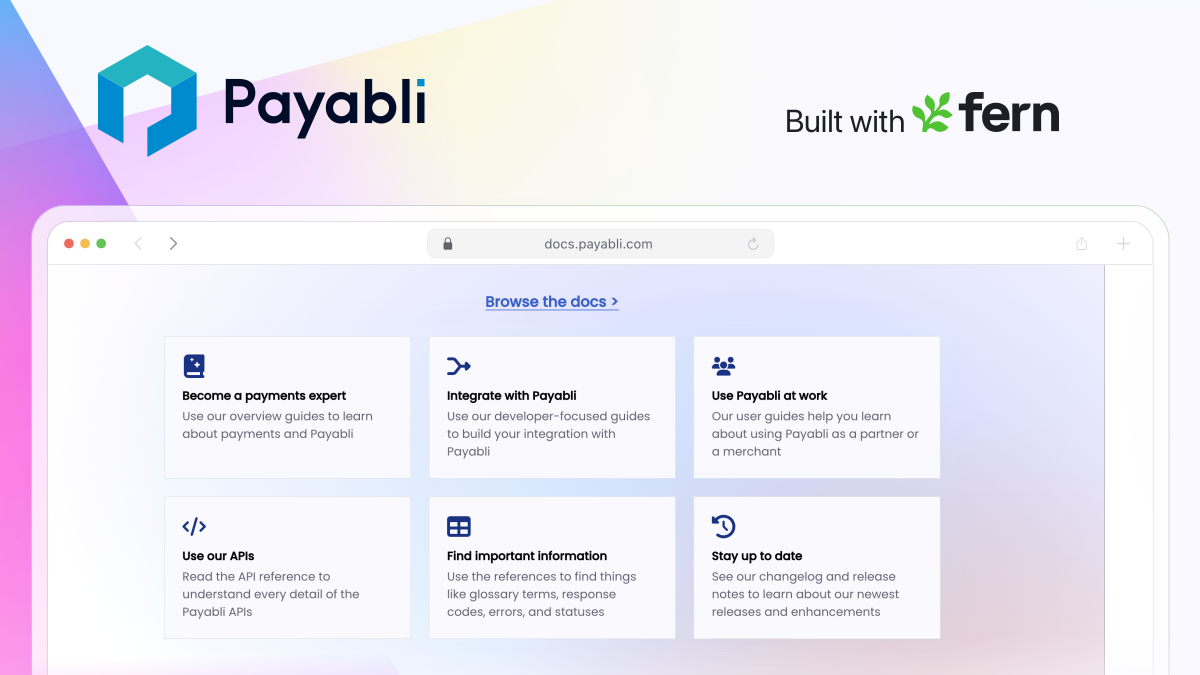
Payabli’s New and Improved Payment Documentation – Powered by Fern. 

We’re excited to announce a major upgrade to Payabli’s payment documentation and developer site — making it faster, clearer, and easier than ever for developers to build on our platform and accelerate their API payment integration.

This is more than a visual refresh. It’s a foundational investment in how we support you—our builders—and a key milestone in our mission to make Payabli the most seamless, developer-friendly payments experience for SaaS platforms. Whether you’re building a full payments stack or just getting started, our improved payment documentation is designed to help you get there faster.

To bring this vision to life, we partnered with Fern — a company reimagining how engineering teams build, maintain, and scale high-quality API documentation and SDKs. Inspired by internal tooling at companies like AWS and Palantir, Fern’s platform powers some of the cleanest, most developer-friendly experiences we’ve seen — and now it powers ours at Payabli, too.

What’s New (And Better)

We didn’t just change platforms—we rebuilt the experience with developer usability at the core. For you as a developer, this means:

  • Logical, cleaner navigation
    Endpoints are now grouped by the objects they belong to — not hidden in broad “reporting” sections. For example, the Pay In transaction query endpoints now live in the Pay In section instead of the general queries section.

  • Code examples that stay in sync
    Many examples are sourced directly from our API spec. That means one source of truth — and no more outdated copy-paste errors.

  • Smarter search functionality
    Tabbed search results separate guides, endpoints, and references — so you can quickly zero in on what you need.

  • Interactive, developer-first API playground
    With Payabli’s API Playground you can try endpoints with pre-filled examples, helpful error responses, and a cleaner interface that makes it easier to test and understand endpoints.

  • Auto-generated Postman collections
    Our Postman collection is now kept in sync automatically — no more mismatches between tools and docs.

  • Improved readability for complex data
    Tables expand to fullscreen and custom components make scanning large datasets or request structures much easier.

  • Community feedback
    Every page of our new Docs site includes the ability for our users to give direct feedback on the content

Building What’s Next

This launch sets the foundation for even more developer-centric enhancements we’re working on:

  • Official SDKs (coming soon!)—automatically generated and always aligned with our API spec
  • More interactive features—think guides, tutorials, and hands-on flows
  • Community feedback loop—we want to hear what’s working and what’s not

Try the New Docs!

Big thanks to the team at Fern for being an incredible partner throughout this rollout. Their platform has helped us level up the way we deliver payment documentation and their support made the transition smooth from start to finish — and we’re proud to be building alongside them. 

Check out the new Payabli Developer Docs and let us know what you think. We’re always looking to make the developer experience even better — so if you have feedback, questions, or want to help shape what’s next, reach out to us at docs@payabli.com. We’re kicking off user research soon and would love to include you. This launch is just the beginning, and we can’t wait to show you what’s next!

How to Accelerate Embedded Payments Adoption with the Right GTM Strategy

This is post four of a multi-post series with Ershad Jamil, former Chief Growth Officer at ServiceTitan.  Ershad shares his experience in launching embedded payments for ServiceTitan to guide similar Vertical SaaS companies.

Over the course of this series, my goal has been to help other vSaaS operators think strategically about how to optimize their Payments business and drive embedded payments adoption. Even better, I hope that by sharing many of the pitfalls I encountered while building ServiceTitan Payments, you can avoid the same mistakes.

I’ve covered How to Drive Customer Growth with Embedded Payments, How to Choose the Right Payments Partner, and How to Structure Pricing to Maximize Value and Customer Adoption.  It’s time to shift gears from foundational strategy and decisions to GTM execution.  

Think like a business owner

When I first started building out payments at ServiceTitan, I planned the Go-To-Market (GTM) approach like I was building my own business, not adding on a product to an existing platform. By thinking about our embedded payments like its own P&L, I considered four core functions and roles: 

  • Sales and Marketing
  • Research and Development
  • G&A
  • Cost of Revenue 

It’s likely that you have many of these functions and roles within your SaaS company already.  It’s worth asking who you can tap into and who you hire net new.  To answer those questions, I always recommend stepping into the prospect’s shoes. Will your existing product marketers be able to help prospects understand embedded payments?  On the sales side, are there existing AEs who could upsell this new product?  Will they understand the nuances that come with payments and be able to drive embedded payments adoption?  Do you expect to drive more adoption from your install base or net new customers? 

At ServiceTitan, we emphasized hiring sales and customer success team members who were from the payments industry.  They already understood pricing and knew the lingo (like calling customers merchants!).  One of the most common mistakes I see with other companies adding in an embedded payments offering is making the assumption that their current AE team can handle the selling. Selling embedded payments is not as easy as it sounds.  Don’t overlook your first, core GTM team members. Remember, you want payments to be a significant part of your business. 

It’s also critical that you identify a team leader who will act like a business owner. This payments leader needs to know payments inside out. If your leader is not from a payments background, make sure they invest in understanding the space. They need to build cross-functional buy-in, establish key metrics, and manage the initial team of 3 to 12 people. 

Flex your GTM team structure

When I was building out ServiceTitan’s GTM team for payments, redundancy and flexibility were key. The first three hires were sales, onboarding and support.  They were all from the payments industry – they knew the lingo and processes to allow us to move quickly.  Even better, each team member could each step into each other’s roles.  The cross training approach gave us greater ability to scale and provided redundancy for a small team. 

Of the team, the first hire focused on sales and onboarding. Once we gained traction, our next hire focused on implementation.  It wasn’t too much longer after that point that we realized it was time to hire a dedicated support role. While this support specialist could sit within your company’s greater support org, it’s imperative that they work closely with the payments team. Embedded payments adoption requires specialized support – someone who knows how to handle very specific payments questions. A success manager trying to onboard a customer on payments as just 10% of work means you won’t get the right focus or adoption. And, in this ideal GTM launch team, support works in tandem with the sales and onboarding leads as one unit. 

Landing your first customers

Start with the team that’s closest to your customers: Customer Success. Working closely with the existing customer success team at ServiceTitan, we identified customers who would be willing to test out our new embedded payments product. Identifying these first customers wasn’t hard, but convincing them to adopt the new offering was a little more challenging than we anticipated. 

You’ll learn a lot from a small, focused customer group (just 6 at ServiceTitan!) and by dedicating almost full-time support from setup to answering ongoing questions. We discovered there were a lot of nuances in workflows that we wish we had thought about more. And, we had a few product hiccups we had not anticipated. By identifying and working with a core group of customers early, you can get more feedback, make quick changes and continue to move fast. 

I would also highly recommend that you invest in support. A lot of times, we think about the product, about the sales motion and we don’t think about support as an important part of the solution.  Keep in mind your end customers, especially SMBs, might already have an existing payments solution and they are likely not satisfied with their support. You want to provide a better customer journey.  Give your customers the best Tier 1 support you can.  Keep in mind that responsiveness matters.  Invest in measuring not only NPS for your product, but also CSAT for support.  

By investing in support with our first payments customers at ServiceTitan, we created strong customer advocacy.  Our customers were willing to participate in webinars, be quoted in blogs and more.  Your first customers are your greatest asset to win new customers. 

When do you ramp for growth?

Back when I launched ServiceTitan payments in 2016, there were not a lot of benchmarks.  To evaluate if we were ready to increase our GTM team investment, we asked ourselves the following questions:

  • Did we have a decent understanding of average volume of month of credit card, ACH or check size in general?  
  • Were we making these customers successful?
  • How stable was the product?  What was the volume of support requests?
  • What percent of our existing customer base had adopted embedded payments? Could we accelerate that adoption rate?

After nine months, we decided to double-down on our investment in ServiceTitan Payments.  It was a hard decision to make. We were going to take a risk. Hire 10 more people. We might over hire, but we also knew payments could be a significant percentage of company ARR soon enough. Also, we had a strong conviction that every dollar going to our platform, not on integrated payments experience, was a dollar that could have been monetized and a customer that could have had a better experience and received better service. 

It’s always a careful evaluation and balance of risk and reward when you make the decision to invest in your GTM team. Do you hire one more person as planned or go beyond plan?  How much are you leaving on the table? Luckily, we had enough validation with our GTM team structure and early customer signals to double-down. Keep in mind today, you could leverage more AI and automated tooling to supplement your hiring plan.I highly recommend that once you have some data, if the opportunity is there, double down. Growing your GTM team will not only drive acquisition, but helps with gross revenue retention too.

When is the right time to talk to customers about payments?

At ServiceTitan, we made payments part of the core platform implementation lifecycle.  A company goal was to get customers to adopt payments during onboarding. Part of the onboarding sequence was to schedule a conversation with a payments specialist. During this conversation, our payments team scoped their needs, gathered info, and could begin to set custom pricing. Getting customers to sign up for payments during this initial implementation period was a win for both – as it increased our payments velocity and ensured smooth onboarding success for the customer. 

My top 5 keys to GTM success for embedded payments?

  1. Be Nimble. We always thought of operating like a startup within a startup.
  2. Dedicated, single threaded focus
  3. The company has to be all in. Embedded payments must be adopted by all to be successful.  
  4. Sales teams and payments teams need to be aligned.
  5. “Don’t make payments optional” during the implementation process

Stay tuned for the next & last article in this series, where I’ll cover how to continue to innovated with embedded payments, as well as layering on other Fintech to your vSaaS.

Pricing Embedded Payments: Strategies to Maximize Value and Drive Customer Adoption

This is post three of a multi-post series with Ershad Jamil, former Chief Growth Officer at ServiceTitan.  Ershad shares his experience in launching embedded payments for ServiceTitan to guide similar Vertical SaaS companies.

One of the most important considerations of launching embedded payments for SaaS is determining how you price the product. Pricing embedded payments means accounting for all costs associated with the partner you choose and the team to sell, onboard, and support embedded payments. The key question to answer is — “how can I maximize embedded payments value with price and get the most customer adoption?”

The first thing is to understand how the economics work across all parties involved with embedded payments. The three main parties involved with the economics are the credit card issuers (Visa, Mastercard, Discover, Amex), the partner(s) and your Vertical SaaS business. It’s basically a revenue share across all three. It’s also important to understand that credit card cost and pricing is different from ACH or checks – look at the examples below for more detail.

A few pricing basics to know:

  • What are different types of pricing for payments?
    • Qual/Non Qual (e.g., 2.9% + $0.30 / 3.3% + $0.30)
    • 3-tier
    • Intechange+ 
  • Do I charge a premium or do the match or beat pricing?
  • Ideally can charge based on value (i.e., higher than a non integrated experience)
    • Premium: pricing should be your default pricing that the majority of your customers are charged for your Payments offering. Developing a truly embedded payments experience within your platform adds significant value to your customer and their customers and vendors experiences. By standing firm on the value of your embedded offering, you should be able to charge more than what a generic payment processor, ISO or bank is offering for stand alone processing. The best vSaaS platforms inherently understand the value they’re providing by offering a one-stop unified offering and stand firm on pricing commensurate with their value.
    • Match: A subset of your customer base will be resistant to paying more than what they’re currently being charged. Depending on how strategic the customer is you can offer to match their current processing rate. In this instance you would ask for their current merchant statements to corroborate their pricing and offer them that same effective rate. This should be used seldom to not dilute the value of your integrated offering and should be a negotiating tool to request other concessions i.e. up-front fees, longer term, etc. If you’re offering Match pricing regularly you’re not positioning the value of your payments integration effectively and should rethink your approach. 
    • Beat pricing: Similarly to match pricing, for a very minute segment of your customer base you could offer to beat their current payment processing pricing. You should never default to this, but for a highly strategic partner like a Franchisee Group or large Enterprise Chain this could be a tool in your kit to earn their business.  If you’re offering to beat their pricing regularly you’re not positioning the value of your payments integration effectively and should rethink your approach.
  • How does pricing change over time as the payment business evolves over time?
    • As the value of the product goes higher, pricing can shift and be higher
    • Pricing should be based on value and ROI vs. a simple feature
  • How do you consider margins?
    • Need to factor in partner buy rates and the resources it takes to onboard and service customers on embedded payments

Let’s see how an example pricing embedded payments could work for credit cards. 

Say you price your product at 3% for every qualified transaction. Qualified is a low-risk payment made with a physical card that is swiped or inserted into a chip card reader. Qualified transactions are the least complex and have the lowest rates. The specific rate that the credit card companies keep for interchange depends on the card type, the merchant category code (MCC) and other factors. We won’t go into the details, but say Visa keeps 2% for every qualified transaction on your platform. This leaves 1% left that could be shared between the credit card processor and your company. Depending on what you negotiate and work you take on as a software business, you could end up with 0.5% take rate. There are also transactional costs and other fees involved, but this is just a simple example of how the economics work. 

How pricing embedded payments works for checks and ACH

Many software companies also allow their customers to process checks or the digital version which is Automated Clearing House (ACH). ACH is a system that allows for electronic funds transfers (EFTs) between financial institutions. You could charge your customers a flat say $0.99 per ACH or even charge 1% with a dollar cap. It really depends on the value perception of your customers on what they will pay. 

Determining how you price your customers

What is the right pricing for your customers? While it always depends on the industry, the size of your customers, volume and type of transactions, there are a few pricing approaches you should know. Usually as a platform you have to be flexible on the pricing and offer a few options depending on the size of your customer. For example you can offer what’s called a qualified/non-qualified pricing which could look something like 2.9% + $0.20 per qualified transaction and 3.2% + $0.30 per non-qualified transaction. Qualified transactions (also known as a qualified discount) are the least expensive, and non-qualified transactions are the most expensive. Each time a customer buys something using a credit or debit card, the processor determines whether it’s a qualified or non-qualified transaction.

Another credit card pricing model is called interchange+. This pricing is not a ‘fixed’ pricing like qualified/non-qualified meaning as interchange changes based on many factors described above, there is a specific amount of basis points (bps) that you can charge your customer above interchange. So for example, a merchant that does $300k in monthly credit card volume, may want more flexibility on their pricing and get a ‘discount’ and not want the fixed pricing. For this merchant, a pricing like interchange+ 20 bps may be a more competitive offer in order for them to utilize your platform. 

The key to pricing is to initially determine what principles you want to have as an embedded payments product. Do you want to price on value or match/beat the current pricing your customers receive? With embedded payments in one platform, you are typically offering more value and features to help with time savings, efficiency etc. for your merchants, so I always recommend pricing at a ‘premium’ in order to build a long-term successful business line and view embedded payments as its own P&L. If you are pricing as a premium, you also have to deliver the most value to customers regarding embedded features like embedded reporting, refunds, etc. Additional online flexible payment features like allowing the ability to send an email with the invoice/payment link is an example of how your embedded payment solution would be a better solution vs. your merchant using an outside credit card processor. 

Once you have a good idea of pricing and margins, what’s next?

It always comes down to the customer. One thing I always recommend is to build high-resolution designs of embedded payments, articulate the value you will deliver and share it with your close customers. Once you explain the time savings, efficiency gains, etc. you can also share the proposed pricing with some close customers to receive feedback. Some customers will most likely be ok with the pricing and others may be a bit skeptical if it would mean they would be paying more. This doesn’t mean you should drop pricing from the beginning. It takes time to build out the product and actually show real value, so you should stick with your initial assumptions and do proper alpha/beta testing with live customers. 

Additionally in parallel, it’s best to have a dedicated payments team that can sell, onboard and support customers for your SaaS platform. This team could sell other products but ideally a few folks on the team have a payments background who can help others ramp on the payments terminology and processes. Determining if and how to show pricing on your website depends, and this team will also have great insight to help you determine the best approach.

We’ll discuss the team and operationalizing payments in the next article!

Podcast: Payment Operations: How Streamlining Your Back-Office Can Unlock New Revenue Opportunities

In the ever-evolving world of fintech, payment operations—commonly known as Pay Ops—are becoming a critical component for software companies looking to optimize their payment processes. While many businesses focus on the transactional side of payments, the operational side—merchant onboarding, risk management, compliance, and payout orchestration—often gets overlooked. However, neglecting Pay Ops can lead to inefficiencies, higher costs, and compliance risks.

In our final episode on the Leaders in Payments podcast, hosted by Greg Myers, Payabli’s Co-Founders and Co-CEOs, Jo Phillips and William Corbera explored the growing importance of Pay Ops and how Payabli is pioneering advancements in this space. Here’s what software companies need to know about modern payment operations and why embedding the right Pay Ops strategy is essential for long-term success.

What Are Payment Operations and Why Do They Matter?

Payment operations encompass everything beyond the transaction itself—merchant underwriting, pricing controls, reconciliation, fraud detection, and compliance management. For vertical SaaS platforms, these processes can be complex and resource-intensive. Without the right infrastructure, companies may struggle with slow merchant onboarding, high chargeback rates, and inefficient fund flows.

Payabli is reshaping the Pay Ops landscape by providing software companies with a unified infrastructure to streamline and monetize payments. By integrating Payabli’s API-first payment solutions, software platforms can optimize their Pay Ops, improve cash flow, and enhance the customer experience.

Payabli’s API-First Approach: Empowering Software Platforms

One of the key differentiators that Payabli offers is its API-first approach to payment operations. This means that software platforms gain flexibility and control over their Pay Ops, enabling them to customize:

  • Merchant onboarding – Automate KYC and underwriting processes.
  • Risk and compliance – Leverage AI-driven fraud detection and risk monitoring.
  • Pricing and monetization – Implement dynamic service fees and revenue-sharing models.
  • Payment routing – Optimize payment flows for cost efficiency and better conversion rates.

By leveraging Payabli’s infrastructure, software companies can move away from rigid, traditional payment facilitation models and build a more scalable, customizable payment system tailored to their business needs.

Real-World Impact: How Payabli Is Transforming Payment Operations

Payabli’s impact on software businesses is already evident. Here are two real-life examples showcasing the power of modern Pay Ops:

  • Property Management SaaS Platform: A leading property management company initially operated as a Payfac but faced significant operational overhead. By switching to Payabli, they decommissioned their Payfac model, refocused on their core business, and streamlined their Pay Ops using Payabli’s infrastructure and Pay Ops suite.
  • Regional Bank’s Online Payment Portal: A regional bank integrated Payabli’s payment infrastructure into its online banking platform, enabling small businesses to access payment processing services with ease. This transformation enhanced their customer experience while improving security and compliance.

The Future of Payment Operations: AI, Risk Management, and Efficiency

As Pay Ops continues to evolve, AI and automation are becoming essential for fraud prevention, underwriting, and compliance. In the podcast, Jo and Will emphasized how AI-driven Pay Ops can:

  • Reduce fraud risk by analyzing transaction patterns in real-time.
  • Automate underwriting to onboard merchants faster and more efficiently.
  • Enhance security by detecting and preventing suspicious activities before they escalate.

For software companies struggling with inefficiencies in their Pay Ops, adopting an API-driven, modern payment operations strategy is no longer optional—it’s a competitive necessity.

Optimizing Payment Operations with Payabli

For SaaS platforms aiming to embed payments, optimize revenue, and enhance user experience, partnering with a next-gen Pay Ops provider like Payabli is the key to success. With a flexible, API-first infrastructure, Payabli empowers software businesses to take control of their payment operations, streamline workflows, and unlock new monetization opportunities.

Watch the podcast here:

To learn more about how Payabli can transform your payment operations, check out our latest insights or connect with us today.

Interested in learning more about our Pay Ops offering? 

Schedule a demo with one of our payment experts today.

Podcast: Mastering Payouts & How Vertical SaaS Platforms Can Take Control and Unlock New Revenue Streams

As embedded finance continues to evolve, more software platforms are integrating payment acceptance to create new revenue streams. However, many businesses overlook the potential in payouts – a critical yet often misunderstood component of payments infrastructure. In the second episode of Payabli’s series with the Leaders in Payments Podcast hosted by Greg Myers, our co-founders and co-CEOs, Will Corbera and Jo Phillips, dive into why payouts are becoming the next frontier for SaaS platforms and how businesses can capitalize on this shift.

Why Payouts Matter

Most software companies understand the value of embedding payment acceptance, but payouts remain an afterthought. Traditionally, payouts have been viewed as a simple settlement function—sending funds to merchants, gig workers, or vendors. However, Payabli takes a different approach, treating payouts as a fully embedded payables solution that enables SaaS platforms to streamline money movement and unlock new revenue.

Many businesses still issue thousands of manual checks each month, creating inefficiencies, delays, and unnecessary operational costs. Automating this process through a unified API eliminates these bottlenecks while improving vendor relationships and compliance.

How SaaS Companies Can Monetize Payouts

One of the biggest takeaways from the conversation was that payouts can be a major revenue driver—sometimes even exceeding payment acceptance. This is achieved through:

  • Virtual card issuance – Vendors are paid using virtual cards, generating interchange revenue when the payment is processed.
  • Enhanced ACH transactions – Faster and more reliable ACH payments can be monetized as part of an embedded solution.
  • On-demand payouts – Real-time disbursements provide flexibility for businesses while opening new revenue opportunities.

The Shift Toward Embedded Payouts

To fully embed payouts, SaaS platforms must think beyond traditional accounts payable solutions. Payabli follows what they call the Three P’s of Embedded Payments:

  • Pay In – Payment acceptance and acquiring
  • Pay Out – Vendor, supplier, and contractor payments
  • Pay Ops – Payment operations and infrastructure

This comprehensive approach allows SaaS companies to own the full money movement experience rather than relying on multiple third-party providers. By integrating both pay-in and pay-out functionality, businesses create a seamless financial ecosystem that increases platform stickiness and retention.

Security, AI, and the Future of Payouts

As payouts scale, security and risk management become even more critical. Payabli is investing heavily in AI-driven fraud detection, using:

  • Dynamic risk scoring to assess vendor trustworthiness
  • Automated payment decisioning to ensure compliance
  • Real-time monitoring to prevent fraudulent transactions

With faster payments come higher security risks, making AI a necessary tool for safeguarding transactions. The next phase of embedded payouts will likely include even more advanced fraud prevention and compliance automation.

Looking Ahead

Payouts are no longer just a back-office function—they are a key part of embedded finance that software companies can use to drive efficiency, improve vendor relationships, and unlock new revenue. As the industry moves toward a fully embedded payments experience, companies that embrace both money in and money out will have a significant competitive advantage.

For software platforms looking to expand their financial capabilities, the opportunity in payouts is clear. The question is: are you ready to capitalize on it?

Watch the podcast here:

To learn more about Payabli’s offerings and what’s coming next, stay tuned for the next episodes in this series, which will explore Pay Ops.

Interested in learning more about our Pay Out offering? 

Schedule a demo with one of our payment experts today.

Interchange Optimization for SaaS: Maximizing Margins with Smarter Payments

Embedding payments into software platforms has never been easier, but many providers fail to offer the tools and strategies needed for interchange optimization, which is crucial for maximizing margins and optimizing payment portfolios. For platforms monetizing payments, reducing interchange fees through strategic optimization is essential for driving profitability and staying competitive.

Embedded payment providers should do more than just process transactions—they should empower software platforms to maximize their margins. In this blog, we’ll explore how software companies can unlock additional revenue through interchange optimization, covering essential tools, techniques, and strategies for success.

What Is Interchange in the Context of Software Platforms?

Interchange refers to the fees paid by merchants to card-issuing banks every time a credit or debit card transaction is processed. These fees are typically a percentage of the transaction amount, plus a fixed fee, and they form a significant portion of the overall cost of accepting payments.

For software platforms offering embedded payments, interchange is a critical cost factor that directly impacts profitability. While interchange is often seen as a fixed cost, the reality is that it can vary based on several factors, including the type of transaction, the merchant’s category, and the data provided during processing.

Optimizing interchange is especially important for software platforms that monetize payments. By lowering interchange costs for their merchants, platforms can improve margins while offering competitive rates and a better overall experience for their users.

Understanding the mechanics of interchange—and how to influence it—puts software platforms in a stronger position to drive profitability and create value for their merchant customers.

The Importance of Optimizing Your Interchange

Optimizing interchange is not just about cutting costs—it’s about driving long-term profitability and staying competitive in the software space. For platforms monetizing payments, even small reductions in interchange fees can result in substantial margin improvements at scale.

Moreover, optimizing interchange demonstrates value to your merchants by lowering their payment processing costs, which enhances their loyalty and trust in your platform. With rising competition in the embedded payments space, taking a proactive approach to interchange optimization can be a key differentiator that sets your platform apart.

The right strategies and tools enable you to turn interchange from a cost center into a profit-driving opportunity.

Key Tools for Extracting More Margin

Understanding the Components of Interchange

Interchange fees represent a significant portion of the costs your merchants or SMB customers pay for payment processing. By managing these components effectively, you can unlock substantial savings.

The key factors impacting interchange include:

  • MCC (Merchant Category Code): Properly categorizing your clients into the right industry codes can dramatically lower interchange costs. For instance, a business categorized as a “Professional Service” may face higher fees than one classified as “Healthcare,” even if they perform similar services.
  • Transaction Indicators (CIT/MIT): Transactions are categorized as either Merchant-Initiated (MIT) or Customer-Initiated (CIT). Correctly using these indicators reduces costs, improves fraud prevention, and ensures proper interchange qualification.
  • Level 2 and Level 3 Data: Providing detailed transaction data, such as tax amounts, invoice references, and itemized product breakdowns, qualifies merchants for lower interchange rates. This is especially critical for B2B transactions.
  • AVS and CVV Data: Address Verification System (AVS) and CVV checks reduce fraud and unlock better interchange rates. Payabli requires these data points to optimize transactions and help partners maximize margins.

 Additional Methods to Lower Costs

  1. Network Tokens
    Network tokens, managed by card networks like Visa and Mastercard, replace real card numbers with secure, unique identifiers. These tokens are critical for reducing fraud in card-not-present transactions (e.g., online payments) while also lowering interchange fees by up to 10 basis points (BPS). This margin increase requires minimal effort from the software platform or its merchants.
  2. Convenience, Surcharging, and Service Fees
    While Pass-Through Fees do not necessarily impact Interchange, compliantly  passing fees to customers, is an effective way to reduce processing costs while increasing profitability. Here’s how:
  • Convenience Fees: Applied for payments made through non-standard methods, such as online or over the phone.
  • Surcharge Fees: These fees are added to credit card transactions, offsetting the merchant’s processing costs.
  • Service Fees: Similar to convenience fees, service fees are designed for specific MCCs and involve two transactions: one for the service fee and one for the payment itself.
  • Cash Discounts: Merchants incentivize customers to pay with cash by offering discounts, avoiding card processing fees altogether.

Monthly Reviews and Pricing Strategy Consultations

At Payabli, we don’t stop at providing tools. We actively work with our partners to ensure they’re maximizing profitability through regular business reviews and tailored pricing strategies.

  • Partner Reviews: Each month, our team of experts evaluate your portfolio’s performance and identify opportunities for increased profitability.
  • Pricing Suggestions: Based on industry trends and transaction data, we offer recommendations to help you adjust pricing for optimal margins.
  • Flexible Pricing Tools: From offering discounts for new client enrollments to setting up custom fees, we empower you with flexibility to grow your business.

Why It Matters

By leveraging tools like network tokens, interchange optimization, and strategic pricing, software platforms can unlock better margins without compromising on customer experience. With the right provider, like Payabli, these processes are seamless and bundled into a unified solution.

If you’re ready to enhance your embedded payments strategy, lower processing costs, and extract the margin you deserve, Payabli is here to help.

Ready to optimize your payments stack? Contact us to learn how we can help you drive better margins and profitability for your platform.