
Key takeaways
- Tap-to-pay turns a merchant’s phone into a card terminal, so in-person payments run inside your app with no hardware to ship, and that volume becomes new processing revenue for your platform.
- Contactless is now the in-person default: 42% of card payments worldwide in 2024. A merchant who can’t take a tap loses the sale, and your platform loses the volume.
- It’s an SDK you embed, not a separate app merchants download, so online and in-person payments run through one integration with unified reporting.
- Payments that used to leak to checks, cash, or third-party apps now run through your rails at the margin you set.
86% of global consumers use contactless payment methods, but inside most SaaS platforms, in-person payments still depend on separate terminals, mailed invoices, and checks. Customers tap cards to pay at every retail store and restaurant, but when it’s time to pay a contractor, a property manager, or a healthcare provider, merchants are still stuck juggling a disconnected payment experience.
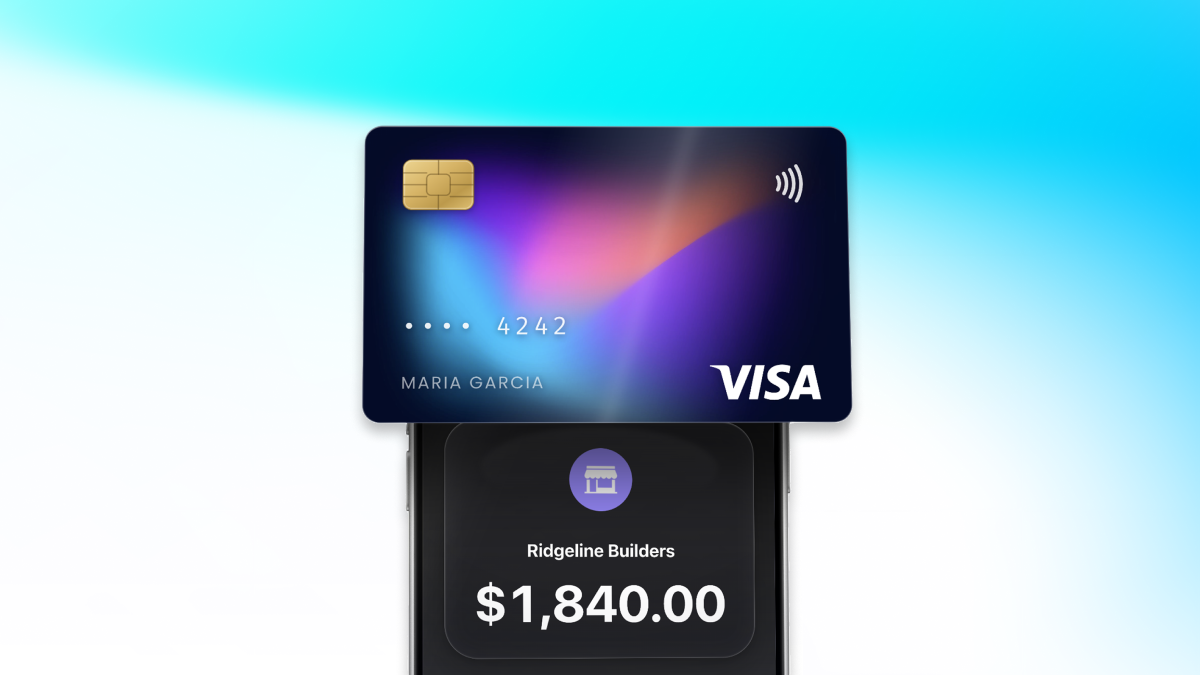
Tap-to-Pay technology brings in-person payments into your platform. Your merchants accept cards and digital wallets on their phone, inside your app: no hardware, no disconnect, new processing revenue for you.
What is Tap-to-Pay?
Tap-to-Pay (also known as SoftPOS) technology turns a smartphone into a contactless payment terminal. Instead of swiping, dipping, or keying in a card number, the customer simply taps their contactless card, phone, or wearable against the merchant’s device. The payment is processed securely through the phone’s built-in NFC (near-field communication) technology, the same technology that powers Apple Pay and Google Pay on the consumer side.
For SaaS platforms, tap-to-pay isn’t a standalone app your merchants download separately. It’s an SDK that you embed directly into your own mobile application. Your merchants never leave your experience. They collect payments in the same app they already use for scheduling, dispatching, invoicing, or managing their business. The payment happens inside your workflow, not alongside it.
How does Tap-to-pay work?
From your merchant’s perspective, tap-to-pay is simple: open the app, enter the amount, and hand the phone to the customer to tap. But behind the scenes, there’s a lot happening to make that experience secure and seamless.
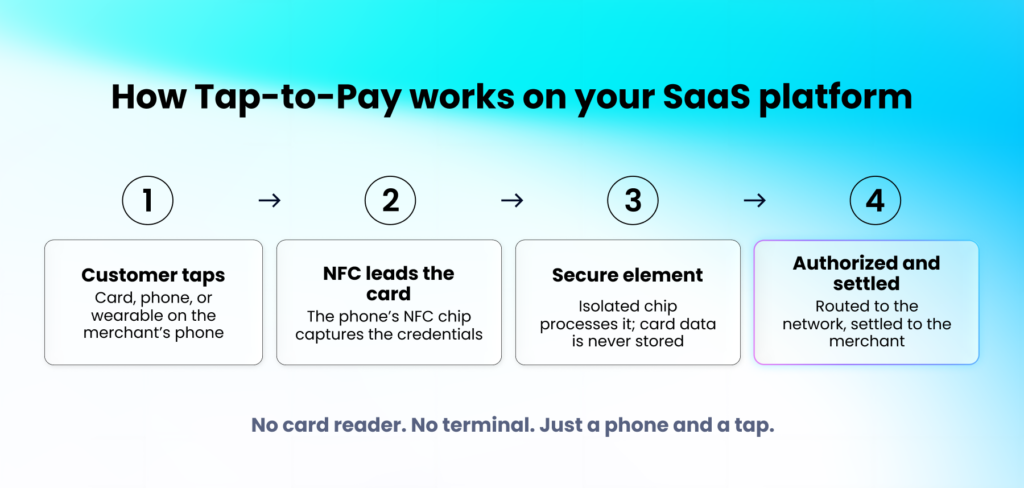
NFC communication
When a customer taps their card or device, the phone’s NFC chip reads the payment credentials through a short-range wireless connection, which is also used in contactless terminals at any retail store.
Device security
The transaction is processed through the phone’s secure element, a dedicated hardware chip designed to store and process sensitive data in isolation from the rest of the operating system. Card numbers are never stored on the device or on Apple’s/Android’s servers.
SDK integration
The platform integrates a SoftPOS SDK into its mobile app. Payabli’s Tap to Pay SDK handles the complexity of NFC session management, payment processing, device registration, and credential security. Your developers interact with a clean, simple API, typically just an initialization call and a charge call.
Processing and settlement
The payment is routed through your payments infrastructure provider (in Payabli’s case, through our platform), authorized by the card network, and settled to the merchant, just like any other card-present transaction.
Where Tap-to-pay makes the biggest impact
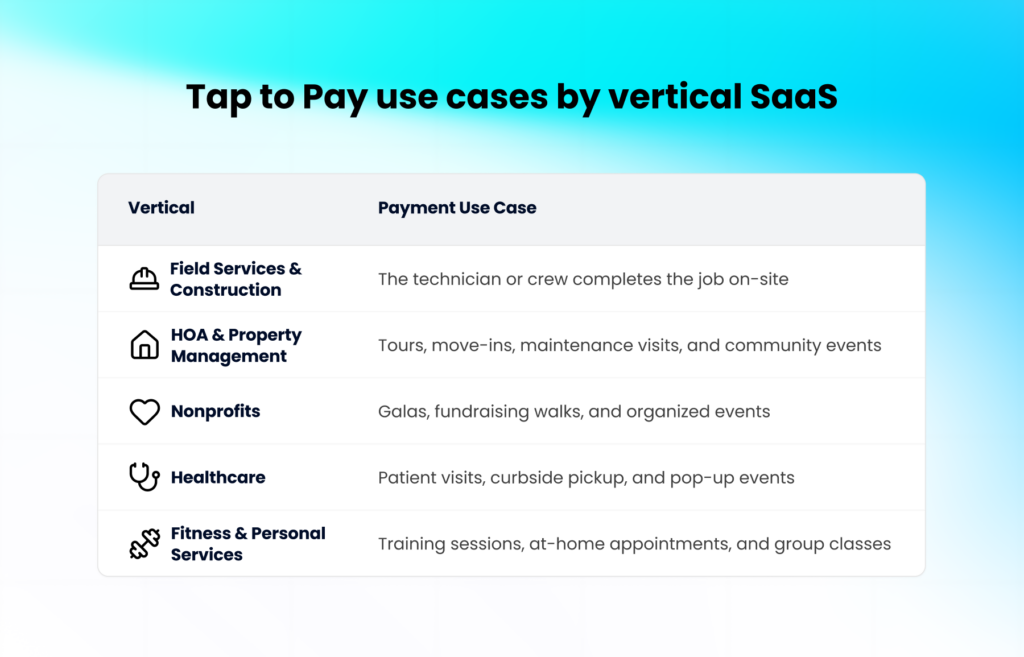
Tap-to-Pay is relevant anywhere a merchant collects payment in person, but it’s especially transformative in verticals where the payment moment happens away from a traditional point of sale:
Why this matters for SaaS platforms
If you’re a vertical SaaS platform, you’ve likely already embedded online payments, collecting deposits, processing invoices, or running recurring billing through your software. But in-person payments have traditionally lived outside your ecosystem. Your merchants pull out a separate terminal at the counter, carry a card reader in their truck, or worse, collect checks and cash that never flow through your platform at all.
That’s revenue you’re not seeing and not monetizing.
Tap-to-Pay changes the equation by making in-person payment acceptance as easy to embed as online payments. Here’s what that means in practice:
One integration, online and in-person
When you embed tap-to-pay through the same payments infrastructure you use for online transactions, every payment, whether website, app, or face-to-face, flows through a single integration. Unified reporting, simplified reconciliation, and a complete picture of your merchants’ payment activity across every channel. For your platform, that means richer data and fewer support headaches.
Zero hardware, zero friction
Traditional in-person payment acceptance comes with logistics and cost. POS terminals run $300 to $1,000+ per merchant, a hard sell for platforms whose merchants are mobile. On top of that, you’re managing shipping, firmware, replacements, and support calls. For a SaaS platform trying to scale, hardware is friction.
Tap-to-Pay removes that barrier entirely. Your merchants collect on the smartphone they already carry, with no hardware to buy, ship, or support. New merchants go live quickly, not in weeks.
A new revenue stream
Tap-to-Pay unlocks in-person transaction volume that was previously out of reach. Every payment that used to happen via check, cash, or a third-party platform like Venmo now flows through your platform. You set the processing margin and capture the revenue.
Plus the economics beat the online volume you’re already processing: because the payor taps a physical card or device at the point of sale, tap-to-pay qualifies as a card-present transaction, which carries lower interchange than a keyed-in or online payment. Same volume, cheaper cost basis, wider spread — yours to keep as margin or pass through as a more competitive in-person rate.
Stronger competitive positioning
Most SaaS platforms still ask merchants to use a separate terminal or generic payment app, then manually reconcile in another system. By embedding tap-to-pay directly into your app, payments happen inside your platform: no context-switching, no manual data entry, no friction. That kind of seamlessness builds stickiness.
Go live with Tap-to-Pay, powered by Payabli
Payabli makes it easy to add tap-to-pay to your platform. Our iOS SoftPOS SDK handles the heavy lifting, including device registration, NFC session management, payment processing, and security, so your team can focus on building the experience, not the payments infrastructure behind it.
Available today on iPhone, with Android support coming soon.
Talk to our team about bringing Tap-to-pay to your platform, or explore the developer integration guide to see how the integration works.