
If you’re building embedded payables into your SaaS platform, you’ve likely hit the same bottleneck: getting vendors paid once a bill is approved.
Your merchants approve a bill and are ready to disburse, but the vendor hasn’t shared how they want to be paid. So the AP team starts calling and emailing to collect bank details and routing numbers, and an automated payout becomes days or weeks of back-and-forth.
This is where embedded payables stalls for most vertical SaaS platforms. The bill is approved and the funds are available, but the payment waits because collecting the vendor’s payment details is still a manual process. Your merchants fall back on chasing and check-cutting, your payables volume stays flat, and the revenue embedded in every transaction goes unrealized.
Vendor Payment Links remove the manual chase, making them the easiest way to get any vendor paid.
The manual chase that stalls every payout
Embedded payables only work when the payment can move, and that depends on collecting payment details from every vendor, one at a time.
For high-volume, repeat vendors, this is manageable. Many are glad to set up their payment preferences once and keep them on file, and a Vendor Portal is a strong fit for those ongoing relationships.
But much of your merchants’ vendor base doesn’t work that way. They’re one-time or infrequent payees serving dozens of customers across different platforms. Asking them to create a portal account for a single payment is friction they won’t accept, and the alternative – having AP teams collect details by phone and email – is slow, error-prone, and difficult to scale.
When that chase drags on, the effects compound:
For your merchants: Bills sit in “pending” while AP teams trade calls and emails to track down bank details. When a vendor is slow to respond, teams cut a manual check to close it out, and the automation your platform promised becomes a partial solution.
For your platform: Every payment stuck in manual limbo is a payment that doesn’t move through your rails – less transaction volume, less payment revenue, and a weaker position heading into renewal conversations.
For the vendor: They’re caught in the back-and-forth too, and often wait on a mailed check anyway. The slowest, least reliable method wins by default, simply because collecting their details took too long.
The answer isn’t forcing every vendor down the same path. High-touch vendors are well served by a portal, while one-time and infrequent payees need a faster, self-service way to get paid. Supporting both ensures every vendor is enrolled, regardless of how engaged they are.
How Vendor Payment Links work
Vendor Payment Links flip the model. Instead of your merchants chasing vendors for details, each vendor receives a single, secure link that handles data collection and disbursement in one interaction.
Step 1: A merchant approves a bill inside your platform, triggering a payment link to the vendor.
Step 2: The vendor receives a branded email with a secure payment link. Branding is configurable at the merchant or platform level; Payabli remains invisible.
Step 3: The vendor opens the link and selects a preferred payment method on a clean, hosted page – no account to create and no back-and-forth.
Step 4: Funds are disbursed automatically. The vendor’s payment preference is tokenized and stored, so future payouts happen without another link.
That final step is where the value compounds. Every link interaction builds a tokenized payment profile for the vendor: the first payment requires the link, and every payment after that is fully automated using stored credentials.
What can be configured
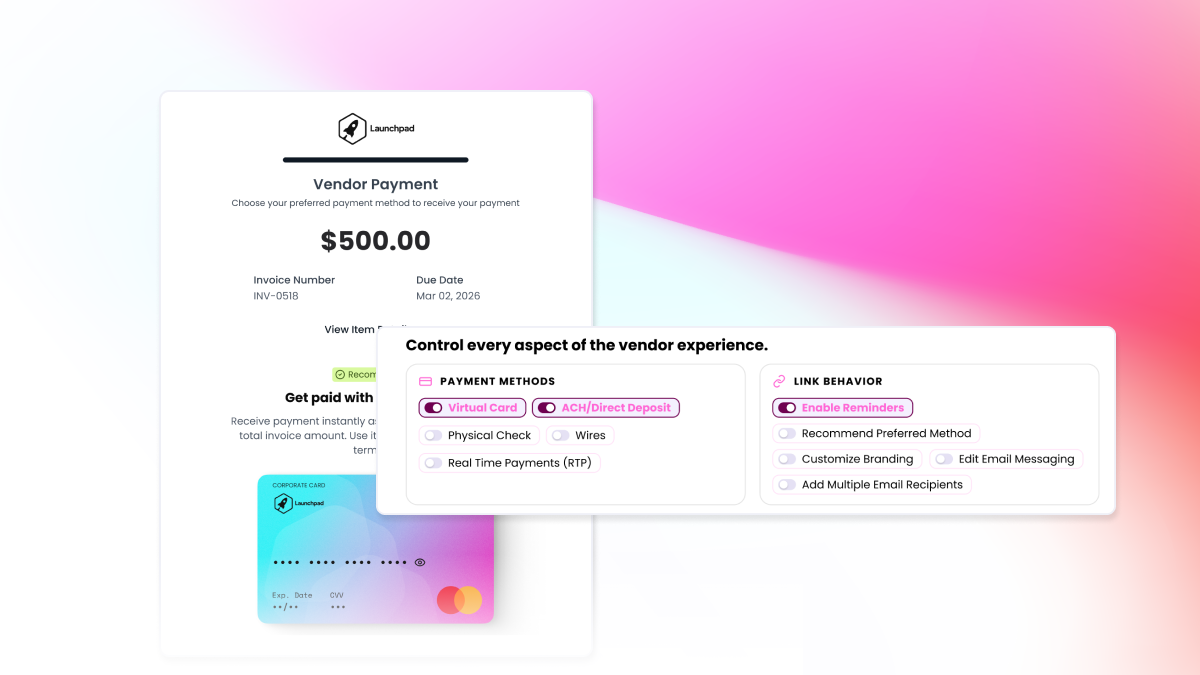
Vendor Payment Links give platforms and merchants granular control over the vendor experience, including which payment rails are offered and how each link behaves.
Payment methods are configurable per vendor or per link. Platforms can offer any combination of virtual cards, ACH/direct deposit, physical checks, wire transfers, and real-time payments (RTP), and can set a recommended default – useful for steering vendors toward virtual cards, where high interchange revenue flows back to your platform.
Link behavior is equally flexible. Merchants can enable automatic reminders for incomplete links, customize the branded email, add multiple recipients per vendor, and tailor the payment page to match their business’s look and feel.
Why this matters for platform economics
Every payment stuck in a manual chase is a payment that doesn’t move through your rails, and every payment that doesn’t move through your rails is revenue your platform is missing out on.
Vendor Payment Links remove the bottleneck entirely. When enrollment is self-service, more payments move through your rails, and more volume becomes revenue – through interchange sharing on virtual cards, markup on ACH, RTP, wire, and check fees, or simply stronger merchant retention because your payables product works end to end.
The option to recommend a preferred method also gives platforms a subtle but powerful lever. Defaulting to virtual cards, for example, steers volume toward the rail with the strongest revenue share without forcing the vendor’s hand. They still choose; you simply make the highest-value option the easiest to select.
The operational impact
Beyond revenue, Vendor Payment Links remove the operational drag of manually collecting and managing vendor payment details.
Fewer manual touchpoints. Rather than reaching out to each vendor and waiting for a reply, AP teams let vendors self-select their payment method through a secure link. Outreach happens once, automatically.
Higher data quality. When vendors enter their own verified details, merchants no longer key in bank information by hand, which means fewer failed payouts.
Healthier vendor relationships. Vendors who get paid quickly keep delivering without disruption. The link experience removes payment friction, so a slow payout never strains the relationship or stalls the service your merchants are counting on.
Vendor enablement that scales. Traditional enablement requires teams to call each vendor individually. That works for smaller portfolios but breaks down across hundreds or thousands of payments. Vendor Payment Links let vendors enroll themselves, with no outreach required.
Stored credentials remove repeat friction. After the first interaction, the vendor’s payment method is securely tokenized on their record, and future payouts reference it automatically. Platforms and merchants can set a default method per vendor so payouts flow without manual intervention.
Where Vendor Payment Links fit in the payables stack
Vendor Payment Links aren’t a standalone product – they’re the self-service collection layer that optimizes the rest of your embedded payables strategy. They give merchants and vendors a frictionless way to exchange payment details without phone calls, manual data entry, or a custom UI, so your platform can scale payouts without scaling manual effort.
Combined with Payabli’s broader Pay Out capabilities – bill management, approval workflows, AI-powered vendor enrichment, ghost cards for recurring vendor spend, and configurable funding models – Vendor Payment Links close the last-mile gap between “bill approved” and “vendor paid.”
Ready to eliminate the vendor payment chase? See how Vendor Payment Links fit into your embedded payables strategy at payabli.com/demo.