
Key takeaways
- MCP is the open standard that lets AI agents use your payments API directly, the way your developers do today. The platforms preparing for it are unifying payments on one agent-ready layer now, so that once agents can act, they do it safely without anyone rebuilding what already works.
- Anthropic released MCP in November 2024. Within a year, it became the de facto standard for connecting agents to tools and data, with thousands of servers built on it.
- There are two MCP roles at different stages. A documentation MCP is live today, handing a coding agent the spec it needs to build the integration without a human in the loop. The API MCP, which lets an agent call the payments API directly to read balances and initiate payments, is still in development.
- Not every MCP server is built the same. A thin one mirrors your API endpoints one for one, while a stronger one groups them into workflows the agent calls as a single capability, where some act and some only read.
- The first money moves in services, not retail. Gartner expects 90% of B2B buying to run through AI agents by 2028, with more than $15 trillion in spend.
If you run a vertical SaaS platform, the payments API inside your product was built for one audience: developers who read the docs and integrate. That audience is widening fast, because AI agents can now read what an API exposes and act on it, and your merchants are starting to put them to work. The Model Context Protocol, or MCP, is the standard behind the shift, and it sits on top of the API you already run.
What is MCP, and how does it work?
MCP is an open standard for connecting AI agents to tools and data. It came out of Anthropic in late 2024 and caught on fast because it solved a problem every team building with agents kept running into. The easiest analogy is USB-C for AI, a single port that any number of devices can plug into.
Before MCP, every agent-to-tool connection was a custom build, which meant ten tools turned into ten integrations and ten things to maintain. MCP replaces that with one interface: a host runs the AI, a client manages the connection, and a server publishes what is available. The agent asks what it can do and calls what it needs, learning your capabilities at runtime instead of having them hardcoded.
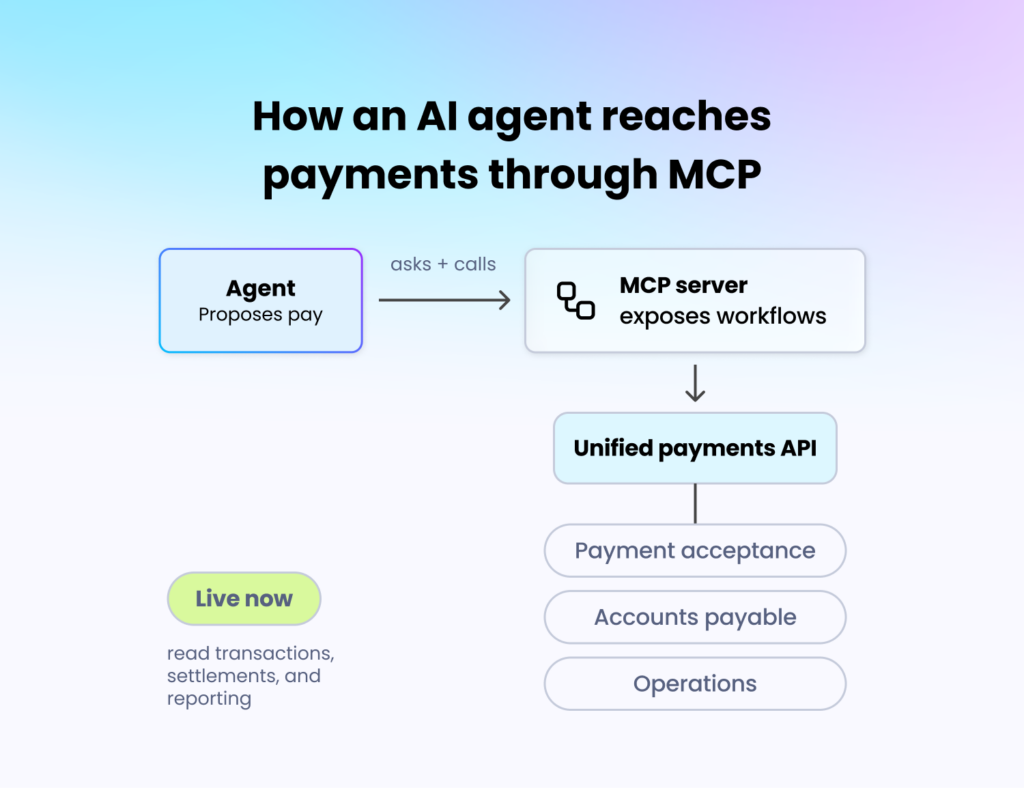
For payments, the server is your payment layer. It tells the agent it can look up a transaction, pull a settlement batch, or check a payout status. The agent reads those capabilities and uses them, without an engineer wiring each one by hand.
How does MCP fit into a payments stack?
A payments stack has three jobs to do around an agent. It has to let the agent in safely, keep it inside a boundary, and record everything it does.
Servers, clients, and workflows
The server is the piece you or your provider runs, sitting in front of the payments API and translating it into MCP. The client lives inside the agent’s runtime and manages the connection. The workflows are what the server exposes. Rather than a raw endpoint, the agent gets a named task, such as checking a payout’s status, with the underlying calls handled for it. It works at the level of the question instead of the plumbing.
How does authorization stay locked down?
An agent that can touch money needs a short leash, and MCP gives it one through scoped, isolated tokens that grant exactly the access intended and nothing beyond it. A token issued for reporting cannot move funds, no matter what the agent is asked to do. This is the same OAuth pattern your team already runs for human integrations, now pointed at a non-human caller, and token isolation is where it earns its keep in payments.
Why every agent action needs a record
You cannot let software touch money without a record of what it did. Every workflow an agent runs is logged with the call, the credential, and the result, so nothing happens off the books. That record is where reconciliation begins, and it is exactly what a sponsor bank will ask to see.
What does MCP unlock for software platforms?
Through a single MCP connection, an agent can reach everything your payments layer does, from accepting payments to paying vendors to running operations. Some of that is available today, and some is still rolling out, so it helps to know which is which before you plan around it.
Agent-initiated payments
When an agent completes a payment on a merchant’s behalf, that is the action side of MCP. As it comes online, a merchant’s agent will be able to start a charge or release a payout on the rails you already run. For now, treat agent-initiated payment as a direction to plan for rather than a switch you can flip today.
Automated reconciliation, reporting, and workflows
This is the near-term win, and it reads rather than acts. An agent can pull a day of transactions, match settlements against payouts, flag the batch that did not land, and answer a finance lead’s question instead of building an export. Group those calls together, and you have a workflow that the agent runs while your team stops living in the spreadsheet. None of these moves a cent, which is exactly why it is where most platforms start.
Conversational merchant onboarding
Onboarding is a back-and-forth of collecting documents, verifying a business, and answering the merchant’s questions. An agent can sit in that conversation, gather what is needed, and surface only the exception that needs a person. It works against the onboarding flow your platform already runs.
How is MCP different from a traditional payments API?
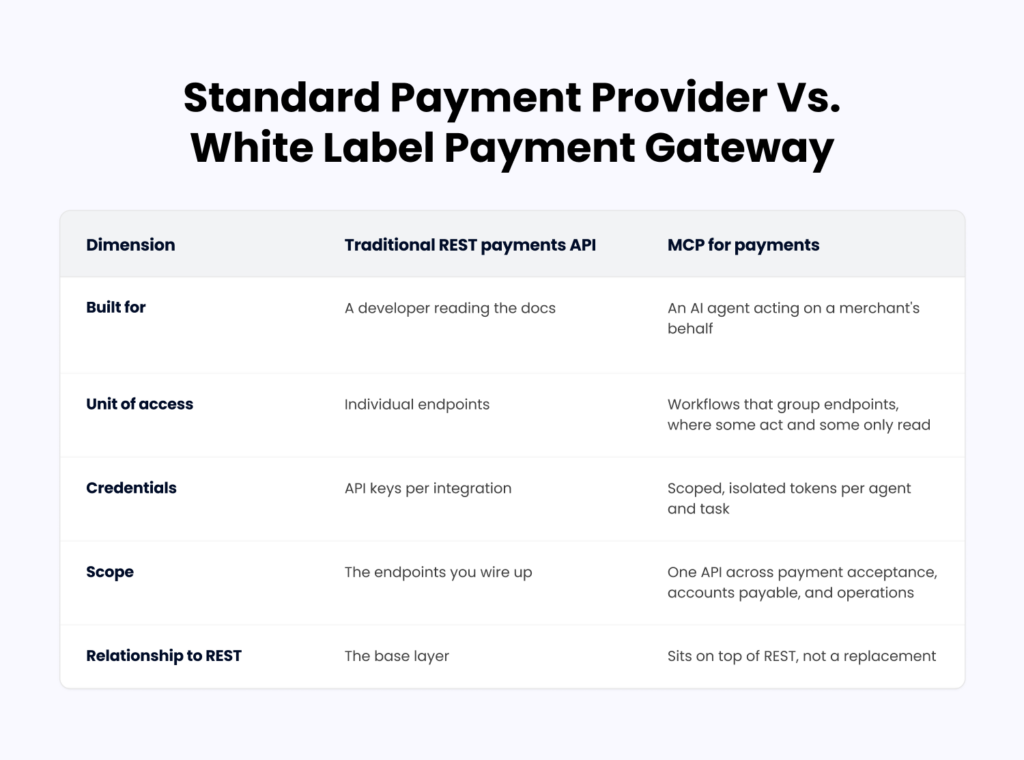
The payments underneath do not change. What changes is who reads the API and the contract it offers them.
 Endpoints vs workflows
A REST API hands you endpoints and trusts a developer to combine them. A well-built MCP server hands an agent workflows instead. We say workflows on purpose, because they are groups of endpoints rather than single ones, and not all of them act, since some only read. The agent calls one capability without needing your API’s internal map.
Built for developers vs built for agents
A REST API is written for a person who reads the documentation and codes against it. MCP is written for an agent that skips both, working off whatever the server exposes right now and picking up a new workflow the moment it appears, with no redeployment on your side. One is a static map, the other keeps itself current.
Where will MCP-powered payments land first?
Most agentic commerce coverage is about retail, an AI assistant buying sneakers or booking a flight. That story does not apply to you. Vertical software runs on a different kind of payment, the recurring, need-to-pay kind, which a business cannot operate without. In construction, community management, and healthcare, getting paid is not a feature in the product. It is the reason the product exists.
Agents do well in these flows because the work is repetitive and rule-bound. A field service merchant can ask whether an invoice has cleared and get an answer pulled from live data, instead of waiting for someone to open a report. The judgment involved is small, and the volume is high, which is exactly the territory where an agent earns its place.
The forecasts point in the same direction. Gartner expects 20% of all monetary transactions to be programmable by 2030, carrying the terms and conditions that let an agent pay on its own authority. Juniper Research puts agentic commerce at $1.5 trillion globally by 2030 and names trust as the biggest barrier. Trust is the reason scoped access and an audit trail are not optional once an agent is moving money.
What should you look for in an MCP-ready payments partner?
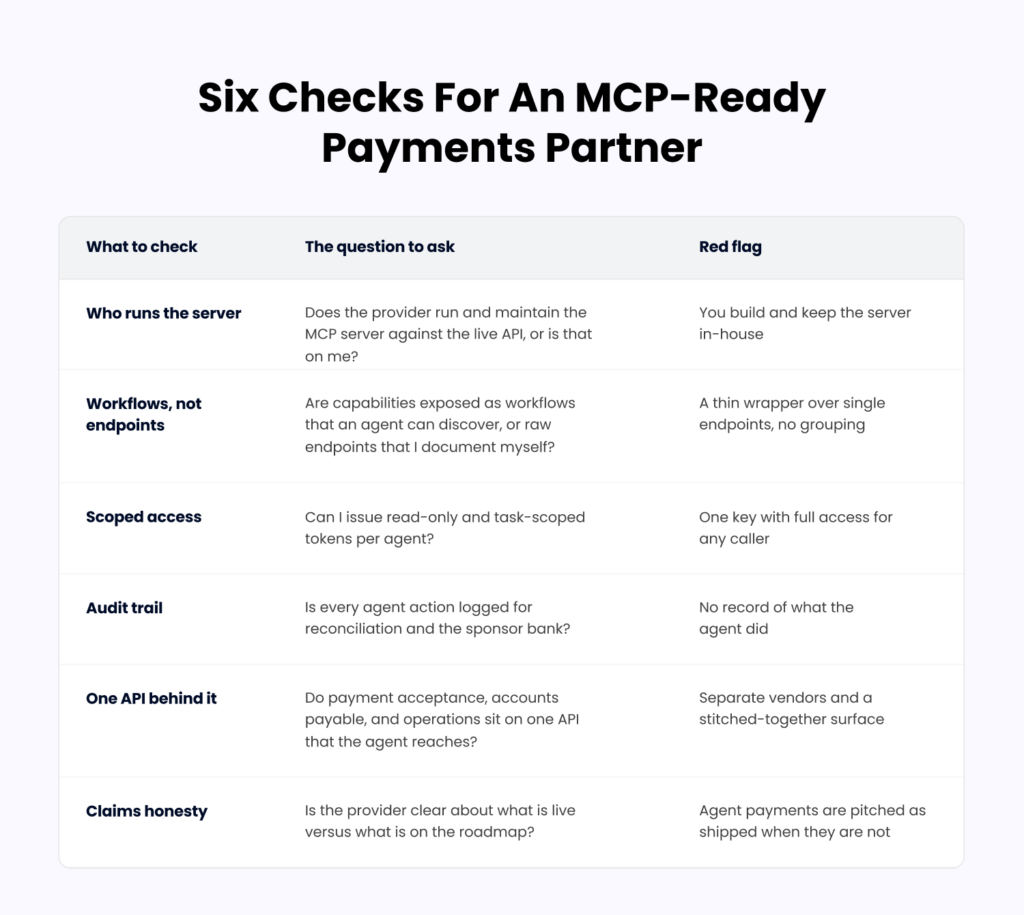
Putting an agent near payments comes down to four things. You need a server that speaks MCP and stays current with the live API, tokens scoped tightly enough to trust a non-human caller, an audit trail under every action, and one place where all of it resolves. Build that yourself, and you are maintaining a protocol layer on top of a payments integration and a sponsor-bank relationship, which is rarely the best use of an engineering quarter. A partner that already runs all four saves you the build, and the questions below reveal who genuinely qualifies:
 How Payabli makes your payments layer agent-ready
With Payabli, Pay In, Pay Out, and Pay Ops already run on one API, the whole payments layer an agent would work against sits behind a single integration you already have.
The piece that opens it to agents is the Payabli MCP Server, now in active development. It’s built to expose Payabli’s REST API as tools an AI agent can call, acting as a protocol adapter rather than an agent of its own; it takes a call, checks the inputs, passes it to the API, and returns the result, with no memory and no decisions of its own. Once live, your customers will be able to add it to their AI tooling, whether Claude Desktop, Cursor, Windsurf, or a LangGraph agent, with a single line of configuration, so their agents can board merchants, investigate transactions, and pull reports in plain language.
ISVs/software platforms can adopt this layer on its own, agent access to the API doesn’t require building on Payabli’s broader agent stack, so platforms can move at whatever pace fits their roadmap.
Need-to-pay verticals will see it first, from field service and community management to construction, healthcare, fitness, and education.
Book a demo to walk through your use case and get early access to the Payabli MCP Server as it ships.
Frequently asked questions
Is MCP replacing REST APIs?
No, MCP wraps your REST API rather than replacing it. Your endpoints keep running exactly as they do now, and the server presents them in a form an agent can read and call. MCP spread as a layer over existing APIs, never a rip-and-replace, so an integration that works today keeps working.
How does MCP handle PCI compliance and sensitive payment data?
The agent never needs the raw card number, and a well-built server never hands it one. Sensitive data stays inside the environment that already carries PCI DSS obligations, and the agent works through scoped tokens that return results rather than card data. No PII is surfaced, and the compliance boundary does not move just because an agent is on the other end of the request.
Do I need to rebuild my payments integration to support MCP?
No, you do not need to, as long as your provider runs the MCP server against the same API you already integrated. That is the point of a single unified layer. Your existing payments integration stays exactly as it is, and the agent-readable surface comes from the provider rather than a second build on your side.