
In our last article, we explored why payments matter when it comes to your company valuation. Now we’re going to dig into the details about how strategic buyers will evaluate your embedded payments. We’ll cover the baseline and standout metrics they want to see and how you should plan your embedded fintech approach to meet those expectations.
Invest in your payments proof points
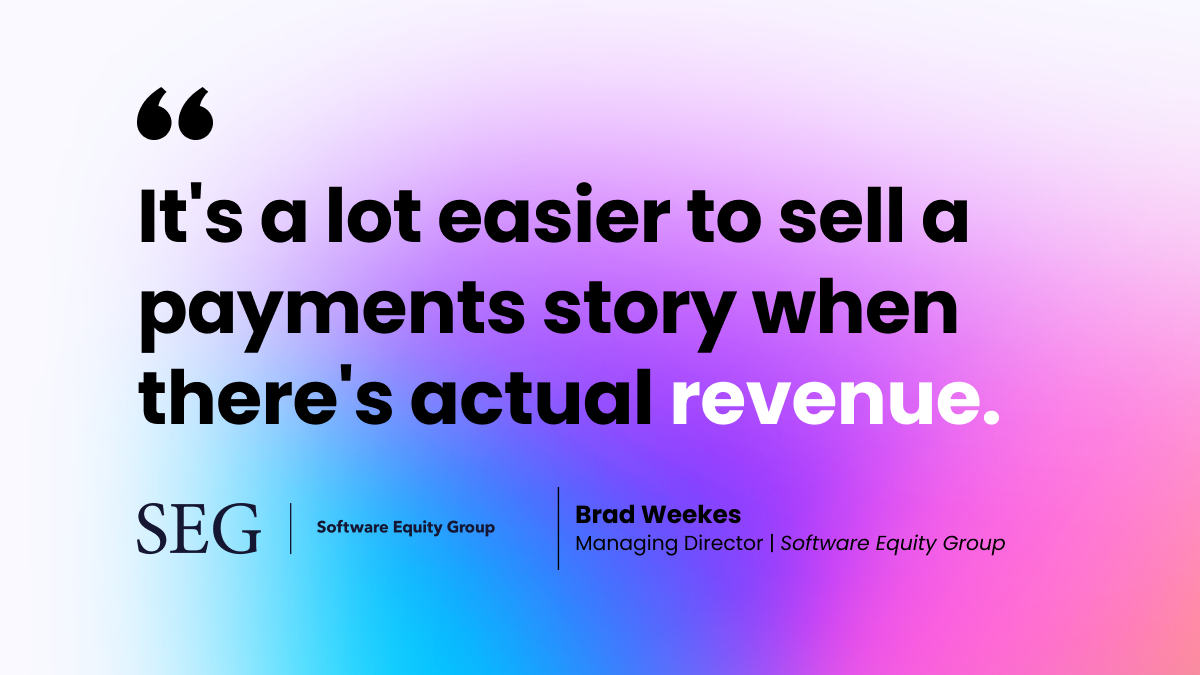
“It’s a lot easier to sell a payments story when there’s actual revenue. Buyers want proof points—not just a narrative.”
You need to demonstrate that payments is not just a capability, but a proven monetization stream. What this means is showcasing real adoption within the install base and increasing penetration over time.
Real adoption means tracking payment volume over time. Showcase how it is trending. Dig into the cohorts over time.
Stop measuring payment penetration as a snapshot. Start measuring it as a cohort.
Most platforms look at payment penetration today and call it a day. But that number tells you almost nothing on its own. The real question is: what did your cohort from three years ago look like when they signed on, and how has that group grown since?
Cohort analysis shifts the conversation from “where are we now” to “are we actually getting better at this.” Are onboarding improvements moving the needle? Is a new pricing model driving faster adoption? Are targeted campaigns pulling more volume through the platform over time?
Track penetration by cohort, and you stop guessing. You start seeing exactly which levers work, and which ones are just noise.
Download the Payments Cohort Analysis Template →
Finally, you need to own your metrics up and down the P&L. It’s not only about total payment volume and penetration rate, it’s knowing your net take rate. You need to demonstrate real ownership over the net revenue line item.
Your Best-in-Class Payments & SaaS Structure
If you’re still debating how to structure your payments into your Vertical SaaS foundation, Brad is certain there’s a winning structure. You want to showcase both predictable revenue and a growth upside. That’s why this model wins:
- Strong SaaS foundation
- Payments revenue layered on top
“SaaS sells seats and workflows—but payments monetizes activity. The customer can grow, and you’re doing nothing, and still generating more revenue.”
This approach de-risks revenue, enhances valuation clarity, and it balances stability and expansion. It shows the most holistic view of your business.
If you’re an earlier stage company, you’ll require a heavier SaaS base. As you scale, you’ll likely need to meet a minimum SaaS floor to ensure buyer confidence. At this stage, you should be working towards a 50/50 revenue split between recurring SaaS and transactional payments. As you continue to grow, buyers are likely going to put an even higher value on payments revenue. As Brad explains, “We try to make the argument that payments revenue can actually be more valuable than contracted SaaS—because it grows with customer activity.”
Characteristics of Top-Performing Embedded Payments Companies
Brad has seen a range of companies come through the pipeline over ten years at Software Equity Group and knows what good looks like.
“The perfect company is one that’s had payments revenue for three or four years, where you can see a steady cohort of growth and consistency, and improved retention over time.”
Here’s what the top-performing companies all bring to the table:
- 3–4+ years of payments history
- Consistent cohort growth
- High payment penetration
- Strong retention metrics
- Payments deeply embedded in workflows
- A Strong Financial Profile:
- Strong Rule of 40
- High gross margins
- Efficient growth (balanced burn)
If you meet these performance standards, you’ll earn strong interest from private equity groups. You’ll also be likely to have more competitive deal dynamics and reach your premium valuation potential.
“If you give me a pure SaaS company versus a SaaS plus payments company with those characteristics—I’m all over it. I know I can get the PE market really excited.”
Why Vertical SaaS Founders Should Act Now
Embedded fintech is becoming a standard, even an expectation, for vertical SaaS companies.
Keep in mind that mission-critical products will always command higher multiples. There is power in niche markets as well – as long as your product is a “must-have” not a “nice-to-have.” There’s a great opportunity in being number one in a small TAM. With niche dominance and payments, you’ll have strong defensibility.
Brad sees a number of high-value verticals on the horizon, including:
- Real estate
- Healthcare
- Government
- Manufacturing
- EdTech
As the market continues to emphasize efficiency and monetization, keep these elements in mind as you build your embedded payments offerings and plan your exit strategy:
- Traction beats vision when it comes to valuation
- Deep integration beats surface-level add-ons
- The best financial model combines SaaS stability and payments upside
By following this guidance, you’ll build a stronger business and create a more compelling exit story.
Payabli can be your partner to accelerate faster time to market, improve monetization and ensure a scalable embedded payments infrastructure. Schedule a demo with our payments experts today.