Category: Blog

Merchant Underwriting: Balancing Onboarding & Risk for Platform Success

You may have read our recent blog on creating frictionless experiences for onboarding. As SaaS Founders we all want to over-index on providing exceptional customer experiences. A smooth merchant underwriting and onboarding experience is key to making a positive first impression. With fraud continuously on the rise, software platforms must take the necessary precautions to ensure they have the proper measures in place. In fact, McKinsey found that 37% of merchants seek fraud prevention as one of their top value-added services in their Payment Service Provider. With more conversations and education around this topic, we already expect that percentage to have risen. By the same token, ensuring the safety and security of your platform so that ‘bad actors’ are not committing fraud should be also considered part of creating positive user experiences.

Not only can bad actors cause significant losses for your software platform, but they can also put your entire payment processing program in jeopardy with Sponsor Banks, Card Networks, and regulators. Some big names in the payments industry have recently come under fire for lax Know-Your-Customer (KYC) policies allegedly enabling activity like money laundering and illicit sales of contraband. In this blog, we discuss how software platforms should balance frictionless merchant onboarding with proper merchant underwriting and risk protocols to build their payments business the right way.

So when we say ‘frictionless onboarding’, we should add an asterisk saying, “for the good businesses who intend to actually use our platforms.”

Defining Good Actors vs. Bad Actors

While we’re not part of the Oscars Committee, Payabli is determined in distinguishing good actors from bad actors. Let’s start with defining what a good actor versus a bad actor means for software platforms embedding payments:

Good actor: A good actor in the context of payments and fintech operates a legitimate business and intends to adhere to the terms of service of your platform as well as payment network requirements or government regulations.

In simpler terms, these are your regular users and clients of your platform who intend to run payments through a legitimate business without breaking any rules and regulations. It’s important to note that some good actors may operate large, complex, or even regulated businesses that require greater due diligence.

Bad actor: A bad actor can come in many forms even when applying just the context of accepting and disbursing funds. These are persons or organizations that engage in fraudulent activities like attempting to attack your hosted or embedded payment capabilities with stolen card data or even worse, trying to impersonate a business by creating a synthetic identity and submitting it as an application for services. There are even cases when good customers develop fraudulent intent, despite having a positive history but have recently changed their motives due to unknown circumstances.

Now that we have a general understanding of good actors and bad actors. Let’s dive into the merchant onboarding and underwriting process that Payment Service Providers like Payabli must perform to enable good actors to process payments and prevent bad actors from infiltrating our ecosystem.

What Goes into Merchant Underwriting?

With the help of automated tools, underwriters at reputable Payment Service Providers evaluate the application based on a variety of methods such as but not limited to:

  • Blocklists: To identify previous bad actors, any suspicious demographics, how frequently the same application details have come through, and many more functions to prevent repeat offenders.
  • Fraud and Identity Verification: Reputable Payment Service Providers want to catch bad actors immediately. This includes rules for detecting synthetic identities, reviewing device and browser details, geolocation, and more.
  • Know Your Customer (KYC): To confirm the identity and accuracy of the information on the application about the business and its owners.
  • AML, Sanctions, and Watchlists: To meet our regulatory obligations by verifying the business and its owners against the list of sanctions, politically exposed, and other government lists.
  • Creditworthiness: Credit risk will vary by product and client so it’s important to be flexible. Payment Service Providers will evaluate businesses and their owners based on industry type, transaction volume, financial stability, and other factors.

Upon approval, businesses are set up with an account and provided with payment processing capabilities for collecting invoices for goods and services and paying their bills to vendors. However, even with approval, it’s wise to have compensating controls for mitigating credit and other types of risk after onboarding.

Balancing Frictionless Boarding with Comprehensive Risk Management

Risk processes don’t have to be invasive or require intense back and forth between applicants and risk teams. Modern risk capabilities should operate continuously throughout the customer’s interaction with your platform. For example,

  • When a user creates an account – a Payment Service Provider like Payabli can identify where the application is originating in the background and compare that with information being submitted to calculate the physical distance between them. We can then block that IP from submitting further information to our platform.
  • When an unknown customer attempts to process a transaction – we can hold transactions from being captured and processed when they occur at suspicious times like 3am. The user may see an authorization but it will not settle until a risk officer approves it.
  • When someone attempts to login into an account – we can compare this with a history of previous interactions to detect anomalies in their login attempt such as an unrecognized device. We can then push an alert to the account owner that someone has attempted to log in from a different device and IP Geolocation than normal.

Using tools that operate discreetly allow software platforms to manage their risk without noticeably impacting good actors. It’s important to note that False Positives can still arise so it’s wise to collect more information. Typically, a bad actor won’t upload bank statements, much less get on the phone when we catch them. This quickly hampers their attempts. Most good actors are well aware of review processes for financial products and feel safer when a partner does verify their information.

Streamlining Complex Businesses with Care

Setting expectations is crucial in life and especially in payments. Every vertical is different so you don’t want to use the same rules, conditions, or requirements to underwrite them all. There are certain industries and business sizes that will require greater due diligence than the average micro-merchant. When we are working with these types of businesses, it’s useful to ask for information up-front or to automate additional tasks. A few examples could be:

  • A large construction company requests merchant services but processes some very large transactions worth hundreds of thousands. Our partners can choose to segment their boarding processes with templates so that their enterprise customers like this construction company get asked to upload financial statements as part of their application process.
  • A seasonal business invoicing thousands of dollars with advanced payments for services has requested processing. Based on these inputs, we can automatically pull financials, assets, liabilities, and balance data to decide without ever needing to interact with the client to determine they are in good standing.
  • A fitness studio that offers high-ticket yoga retreats as an ancillary service to some of their customers has applied for merchant services. Every now and then they receive cancelations but they’ve always been able to return the funds to customers historically with no issues based on a review of their processing statements. However, taking lessons from the start of the pandemic it would be hard to weather all canceled trips. So as part of boarding these types of nuanced scenarios, you let your clients know you will be collecting a rolling reserve as part of the transaction processing to serve as a rainy day fund in case things go south (and I don’t mean to the Bahamas.)

Oftentimes people forget that opening a merchant account is akin to receiving an unsecured loan. When a business asks for a loan they typically expect some financial due diligence to be conducted. At a certain amount of volume requested, you and your customers should anticipate providing some additional financial documentation to mitigate undue risk and prevent bad actors from committing fraud. As we mentioned, certain scenarios and industries will require Payment Service Providers like Payabli to perform this additional level of review. However, it shouldn’t have to be painful or time-consuming for customers. So, working with a partner who understands how to handle this with finesse is key.

*Note: Though we do not cover it in this post, it’s important to keep a pulse on these businesses even after merchant underwriting and onboarding to properly manage your ongoing exposures. Keep your eyes peeled for a future post on ongoing monitoring.

Conclusion

Balancing frictionless onboarding with effective risk management is crucial for your software platform’s success. Distinguishing between legitimate and fraudulent actors, Payment Service Providers like Payabli implement stringent merchant underwriting processes to mitigate risks. It is also important to note that as business owners or software platforms, making the effort to integrate personal interaction and request additional information via phone calls, or other forms of direct communication can yield significant value during the merchant underwriting and onboarding processes.

Through measures like blocklists, fraud verification, and tailored criteria, payment providers like Payabli can strike a balance – welcoming compliant businesses while safeguarding against potential threats. This nuanced approach fortifies platform integrity, fosters trust, and supports sustainable growth in the dynamic digital landscape. ​​

Interested in learning more? Schedule some time to chat with one of our payment experts. 

Becoming a Payment Facilitator: Top 3 Myths SaaS Platforms Face

In today’s digital age, software (SaaS) businesses are constantly exploring new opportunities to expand their services and generate additional revenue streams. One such avenue is becoming a payment facilitator (Payfac), where businesses obtain a special designation in the payments industry giving them more control over their payment operations and better economics in exchange for taking on more responsibility and compliance requirements.

However, the decision to become a payment facilitator is more nuanced and deserves the appropriate context for your business. In this blog, we aim to unravel these myths, shed light on the truth behind them, and share how partnering with a reputable payment facilitator provider can help streamline the journey to becoming a payment facilitator.

Myth 1: Payment Facilitation Will Distract from the Core Business

There’s a prevalent belief that venturing into payment facilitation can divert software businesses from their core focus – and take attention away from resources and the core functions of the company. It is true becoming a Registered Payment Facilitator is indeed a significant amount of effort, and time. The decision to become a registered Payment Facilitator should be carefully weighed depending on numerous factors, however, selecting the right Payment Facilitator provider can allow you to obtain many of the benefits of becoming a PayFac under a Managed PayFac program while maintaining the optionality to graduate into a Registered PayFac when the time is right for your business.

If the context is right for a SaaS platform to become a fully registered payment facilitator, the right Payfac Enabler can make this process easier than ever before. Ultimately, with the right provider, SaaS businesses can focus on their core competencies while expanding their service and product offerings as they will provide a flexible API First Platform that makes integrating simple and can offer both a Managed and Registered program depending on the needs of the Software company.

Myth 2: Payment Facilitation Requires Extensive Resources and Infrastructure

Another misconception about becoming a payment facilitator is the belief that it requires vast resources and extensive infrastructure. It’s crucial to understand that the transition does necessitate certain capabilities, but the magnitude of these requirements largely depends on the intended path taken Managed vs Registered, and the technology provided by the PayFac Enabler.

The truth is, that the scope and complexity of your infrastructure will vary based on your specific business needs, the vertical in which you operate, the size of your customer base, and the volume of transactions you intend to process. The right provider will offer the technology needed for payment facilitation to be incorporated into your existing software platform with relative ease. Additionally, depending on the path taken whether Managed or Registered PayFac the right provider will provide the tooling and infrastructure that can reduce the overall amount of headcount and resources needed and avoid building a payment infrastructure from scratch.

Partnering with a payment facilitator can simplify the transition process. In addition to a Pay Ins gateway for transaction processing the right partner can provide comprehensive Pay Ops tools like merchant onboarding, merchant underwriting, client relationship management, risk monitoring, and a billing engine, which enables software companies to launch with payment facilitation capabilities quickly, securely, and easily. Plus, you’ll still have the ability to own and monitor your payment activities and transactions easily and efficiently all in one place. In turn, this will lessen the demand on your internal resources.

Myth 3: Becoming a Payment Facilitator is Expensive

The perception of high costs often stems from misunderstanding the process involved in becoming a payment facilitator. Becoming a payment facilitator is an investment in your SaaS business’s future growth and sustainability, not just an expense. The costs involved are the groundwork for creating an additional, scalable revenue stream through payment fees. In addition to unlocking new payment revenue, a strong payment partner adds more value for your customers in turn extending customer lifetime value and allowing the software to charge more for their core product.

Integrating with a flexible payment facilitator that can offer software businesses the option of starting with a managed payment facilitator program and grow into a registered payment facilitator program can be more cost-effective and prudent. The right provider can offer solutions tailored to your business needs, eliminating the need for a large team to build your payment infrastructure and helping you optimize your overall investment.

When it comes to your organization’s headcount and resources, partnering with a (Payfac) Enabler alleviates and supports specific areas, including:

  • Payment Operations. The right payment facilitator provider can unbundle key Pay Ops capabilities and offer a-la-carte solutions for SaaS businesses such as boarding, underwriting, risk management, and billing tools. This eliminates the need to task engineering teams to build this from the ground up.
  • Risk management. By partnering with a payment facilitator that offers best-in-class risk management tools, SaaS businesses are provided with the technology needed to optimize their risk management. Whether working under a managed payment facilitator where you offload risk management to the provider or pursuing a registered payment facilitator you can leverage their technology to not have to scale a large in-house risk team.
  • Legal and administrative burden. Under a managed payment facilitator program with a registered payment facilitator provider, SaaS businesses can lean on their provider’s resources and do not have to assume many of the legal and administrative responsibilities that come with becoming their own payment facilitator.
  • The need for additional vendors, service providers, and tools integrations. A payment facilitator provider can serve as an orchestration layer offering hundreds of different risk providers, and tools, allowing Software companies to customize their risk solution with a menu of many different back-end providers via one integration and take advantage of simplistic pricing.   

While it’s fair to acknowledge that there are costs associated with this move, it’s equally important to understand the potential for a robust return on investment. The McKinsey Global Payments Report cited in their 2023 analysis that the “five-year outlook for payments revenue remains strong, with likely revenue growth anywhere from 6 to 8 percent, and that the market remains on pace to exceed $3 trillion in payments revenue by 2027.”

Bain & Company cites that “by 2026 financial services embedded into software platforms will exceed $7 trillion.”

With all this being said, payments should be seen as a strategic investment that can pave the way for sustainable growth and enhanced profitability. It’s about adopting a forward-thinking approach, balancing the initial costs against the potential for increased revenue, improved customer satisfaction, and long-term savings.

Conclusion

By unraveling these common myths, we hope to inspire software (SaaS) businesses to consider the possibilities and benefits of payment facilitation seriously. Additionally, educating themselves and exploring the option to partner with a reputable payment facilitator and orchestration provider like Payabli can offer the guidance, support, and tools they need to navigate the process more efficiently and confidently.

At Payabli, we help hundreds of software businesses navigate their payment journeys in a way that suits their needs and growth goals.

And when your software business is ready to dive head-first into payment facilitation, we are there to support and provide you with:

  • The room for you and your team to focus on your core SaaS products and growth 
  • A comprehensive payments tech stack, with built-in tools and resources, such as risk monitoring, customer relationship management, and more.
  • Cost-effective solutions tailored to your vertical focus and business needs, eliminating the need for additional headcount dedicated to your payment infrastructure.

If you’re interested in speaking with one of our payment experts to learn more about our solutions, contact us here.

Creating Frictionless Experiences: The Key to Successful Merchant Onboarding for SaaS Platforms

As technology continues to reshape the way we conduct digital transactions, software businesses are increasingly embedding payment functionalities into their platforms to expand their capabilities, enable frictionless experiences and create new revenue streams. However, amidst the excitement of embracing and owning the embedded payments experience, one crucial step often stands out as a challenge as software platforms get started on their payments journies  – merchant onboarding.

This blog will delve into key topics and cover everything you need to know about merchant onboarding from what it entails and why it matters, to the common challenges and risks associated, and how partnering with the right embedded payments provider can ensure frictionless experiences.

What is merchant onboarding?

Merchant onboarding is the process through which businesses are brought into the payment acceptance ecosystem of a software platform. It involves the collection of customer details, verification of their business identity, and integration of capabilities to enable them to start processing payments and collecting invoices seamlessly.

Merchant onboarding is a critical step and although it may seem difficult, it doesn’t have to be.

What is frictionless merchant onboarding?

Frictionless onboarding refers to a streamlined and efficient process where customers can complete applications without any hiccups. enables users to complete the onboarding process efficiently, ensuring a smooth and hassle-free experience. Additionally, it provides clear visibility to customers about the status of their application and any additional requirements needed to progress further, allowing for a transparent and informed onboarding journey.

Why does merchant onboarding matter for SaaS platforms embedding payments?

A lot of initial conversations for software platforms focus on the ability to process payment transactions, but onboarding is the start of the payments journey for every platform and should not be overlooked. A seamless onboarding experience greatly improves user experience for software platforms and their customers. With features like automated onboarding, hosted boarding links and embedded components, software platforms gain more visibility and control over the customer experience, while reducing any friction on the customer’s end. These features also allow platforms to white-label and brand their experiences.

A well-executed onboarding process also lays the foundation for a long-term, productive customer relationship. It demonstrates the platform’s commitment to delivering a user-friendly and reliable service, increasing customer loyalty.

Once customer information is collected, they must be verified. Thorough underwriting helps platforms validate the legitimacy of merchants, mitigating the risk of fraud or non-compliance. Additionally, by analyzing the financial history of the business and creditworthiness of its owners software platforms can determine appropriate payment processing terms and risk controls. This ensures a smooth and reliable payment experience for both the platform and its merchants.

Another key aspect is scalability. As software platforms continue to grow and acquire new customers, having smooth and streamlined onboarding automation is essential. This can eliminate the hassle of  sending and receiving paper documents and emails by replacing them with more automated and secure features like e-sign and embedded document uploads.

By simplifying the onboarding process, platforms can effortlessly expand their customer base and handle a higher volume of transactions. This not only saves time and effort but also maximizes revenue generation potential.

What are the common challenges of merchant onboarding?

Software platforms often encounter challenges during merchant onboarding. One challenge is the ease of entering and collecting information from merchants. Utilizing tools like boarding links and embeddable forms like our creator widgets can simplify this process, ensuring a smooth and efficient data collection experience.

Another challenge is managing the status of merchant applications. Platforms need robust systems in place to track and communicate the progress of the application to both the platform and the merchant. Software companies should be able to get play-by-play updates about their users with capabilities like our onboarding webhooks and portfolio management dashboards.This helps maintain transparency and enables timely updates on the status of the onboarding process.

Tailoring the underwriting policy to the specific industry is also a common challenge. Platforms must consider factors like client size, industry-specific risks, and other relevant demographics while formulating their underwriting policy. Working with an orchestration platform like Payabli, can provide software companies with access to hundreds of risk vendors to accommodate any risk profile or factors. This customizability ensures that the onboarding process aligns with the specific needs and expectations of different merchants.

Throughout the process of onboarding merchants, software platforms must be prepared to handle potential underwriting flags. These flags may include TIN mismatches and can occur in large numbers for specific industries. In addition, delayed deliveries may also lead to a need for further diligence. It is important for software platforms to ensure that merchants accurately fill out the onboarding application and are aware that additional documentation, such as previous merchant records, bank statements, and financial statements, may be requested if there are high transaction volumes.

What are the risks associated with merchant onboarding?

Merchant onboarding comes with inherent risks that software platforms need to address. One such risk is fraud, which includes the use of fake identities or stolen data by bad actors. This can lead to financial losses and reputational damage.

Compliance is another critical aspect to consider, as platforms must adhere to regulations such as the Unfair, Deceptive, or Abusive Acts and Practices (UDAAP) and Financial Crimes Enforcement Network (FinCEN) guidelines. Failure to comply with these regulations or other rules can result in penalties and legal consequences.

Misconfigurations pose a risk as well, with errors in pricing, missing equipment, or other setup issues potentially causing financial discrepancies and customer dissatisfaction. It is crucial for platforms to implement robust processes and systems for merchant onboarding to mitigate these risks effectively.

How can SaaS platforms ensure frictionless onboarding experiences of their merchants? 

It’s important for software platforms to partner with an embedded finance provider who can help the platform onboard customers with ease and handle the heavy-lifting. The right partner can not only provide frictionless, digital onboarding experiences with some of the key features mentioned above, but also can help software platforms avoid any risk associated with payments compliance and regulatory laws.

What should I know about Payabli’s merchant onboarding?

Payabli’s Payment Infrastructure & Monetization Platform enables software businesses to build, customize, and manage a frictionless, automated merchant onboarding experience under one umbrella so they can start accepting and monetizing their payments quickly and securely. We can tailor to your business’s onboarding needs and provide flexible options including the ability to onboard your merchants via:

  • Hosted boarding links
  • Embeddable components
  • A direct connection to a single API
  • A hybrid approach, which pre-populates the information you already have and generates boarding links for your merchants to fill out the rest
  • Bulk onboarding – Payabli works with merchants to fulfill any technical or underwriting prerequisites for the bulk onboarding process, with the ability to efficiently pre-underwrite merchants.


Learn more by watching the video below.

Welcoming to the team Adrian Rosario


One of the best parts of starting a business is all the incredible, interesting and talented people you come across on your journey. Shortly after we raised our first round of funding in May of 2022 we were introduced to a fellow named Adrian Rosario. Adrian, was an early team member at Payrix who ended up climbing the ranks to become their first Product Leader responsible over some of their most innovative and strategic products. Fast forward to July 2022 and he was spearheading the embedded payments product and strategy for KeyBank. We were evaluating different Payfac back-bone providers at the time, and were recommended by a mutual friend to talk to Adrian about Key Bank’s Payfac program.

When Will and I hopped on Zoom with Adrian, we hit it off immediately. Not only was Adrian a true payments expert with deep technical chops, he was extremely personable and likable. He also was originally from Miami like Will, and Cuban-American like me. After Will and Adrian traded some Payments war stories from their pasts, Adrian shared a bit about what he was building at the Bank, and we took the opportunity to demo for him the Payabli platform. If I could sum up that first meeting in one sentence it would be “real recognize real”. I remember texting Will about half way through our demo saying “We need an ‘Adrian’ on our Team”. Funny enough later that day we got a text from our mutual friend about how impressed Adrian was with the Payabli platform.

Over the last year and a half since that fateful day, we’ve been building a great friendship with Adrian. From hanging out at Money2020 to impromptu Ramen dinners when we visit Atlanta, we always enjoy breaking bread, talking payments, and getting to know each other. Adrian’s as smart and talented as he is kind and fun, which is why we’re thrilled to welcome him to the Payabli Team as a Product Architect overseeing our Payment Operations suite and broader embedded finance product strategy. Keep an eye out for Adrian, he’s a shining star in Payments and, we’re pumped to see what we build together!

Check out the below interview with Adrian to learn a bit more about him.

  • Give us the spark notes on your Payments Career?
    • Started in an ISO called Benchmark that was sitting above a Pizza shop in Brooklyn.
    •  
       I worked in customer service for the first year shipping terminals, answering phones, setting up merchant accounts, and fixing general problems. Eventually started supporting the risk team and was taught to do underwriting and transaction monitoring for our EVO portfolio.Then I moved to work on a new Payment Facilitator project in the same company called Splash Payments. We built a reconciliation management system and added a payments gateway on top of it. We were growing fast; I had a day where I manually reviewed 300 accounts by hand (running a credit check, checked if their website existed, checked state government for a registry, etc) and told myself I never want anyone to suffer through that again. So I ultimately joined the product team and started designing and building my first system. I’m sorry for the engineers who had to help me learn how to write tickets, understand AWS and make reasonable acceptance criteria. Luckily, we are all still friends. This company eventually became Payrix which is now WorldPay for Platforms. My last couple years, I went to Key Bank where I was a founding member of the Embedded Banking team. We started a sponsorship program with Fiserv and helped them build their Exchange platform. I managed part of Key’s risk engine rebuild and supported the technical builds of the BaaS platforms.
  • What do you love about the Payments Industry?
    • How there are so many problems to solve and so many ways to solve them. It’s like playing with mental legos and trying to design the best castle with what you have. Everyone has different pieces at their disposal so it’s always exciting to see the end results.
  • What’s your craziest Payments Story? 
    • Blocking a transaction on Elton John’s credit card for $50k in cakes and pastries. Then having to get a voice and paper confirmation from his assistant that he was actually buying the sweets. It was not disputed.
  • What motivated you to come build at Payabli?
    • Honestly, everytime I met with Will, we would just discuss things going on in the industry or ideas and he’d get this crazy little twinkle in his eyes as the gears started turning. I thought to myself that’s definitely someone I would enjoy working with.
  • What are you most excited to be working on at Payabli?
    • There are a lot of companies who do similar things to us but very few who can string it all together seamlessly, not even Stripe has succeeded under the hood. I am excited to try to piece together all our systems into an experience that our software partners and their clients truly love.

Introducing Creator

Building a company, it’s incredible how much your original idea evolves from when you first began. We at Payabli have built a lot of product in the last 3 years, however pretty early on in our journey, when Will first proclaimed, “We’re building the AWS of Payments”, I kind of laughed it off initially. The release of the Creator makes that statement more true than ever.

At Payabli we’ve ventured the audacious challenge of creating a truly API-fist payment infrastructure to unify the 3ps: Pay In, Pay Out*, and Pay Ops. Each one of those vectors contains multiple multi-billion dollar companies and possess immense complexity and difficulty. I guess we really took Sam Altman to heart when he said “it’s often easier to succeed with a hard startup than an easy one.”

While our core offering is truly API-First and we will always tout this as our strong suit, we’ve also always strived to meet our Partners where they are. The cats out of the bag that Software Companies are Payments Companies and Founders have never been more keen to obtain that revenue unlock. The Creator is intended to be a supplement to our existing APIs to help Software companies accelerate their time to go-live and payment monetization when they’re resource constrained or have other urgent priorities on their roadmap. The Creator allows users to fully customize and make seamless to their UX the core payment experiences needed to launch embedded payments without writing a line of code. Everything from the text font on the Checkout component button and background print on a v-Card to the header field names on your transaction report and boarding link progress bar color is fully customizable. While the product is now in open beta, we are heavily investing in the Creator and many more features will be componentized in the future.

We’re extremely excited about this launch not only because we believe it will significantly help our partners, we think they’ll have a lot of fun building with it. The Creator is just another tool in our Developer friends kits to embed and monetize Payments. Whether you’re looking for omni-channel payment acceptance solutions, ways to monetize Payables, or a wide array of Payment Operations solutions from Boarding and Billing to Underwriting, Risk Management and beyond, Payabli’s got you covered.

Stay tuned for more announcements soon. We can’t wait to share with you what we’re releasing in Q4.

https://youtu.be/-LJQtI0DtEU?si=-vdy-eu5fHxmoM36

* Payout: While some of our competitors refer to Payouts as funding or settlement to a merchant account, our definition is helping software companies monetize any number of payment issuance use-cases to a given recipient.

Unlocking Greater Margins with Interchange Optimization

Early on in the journey of founding Payabli, we were Centavo Inc., we had no product and were selling legacy processors APIs trying to prove we could sell SaaS companies on monetizing their Payment Processing. Looking for any way that we could maximize our value to our prospective Software Partners we stumbled on this fascinating concept called Interchange Optimization.

If you’re somewhat familiar with Payments economics you’re likely familiar with Interchange; the wholesale costs that Card Issuers receive on each transaction processed. Interchange is typically the bulk of the charges that Merchants end up paying when a credit card transaction is processed. We learned that by passing additional information called Level 2 and Level 3 addenda data you could reduce these interchange costs on B2B Transaction by between 30 basis points (.30%) and 110 Basis Points (1.10%). When I heard this suddenly the raucous Hip-Hop anthem “I’m on a New Level” by Rapper’s ASAP Ferg and Future started playing in my head; this was going to be a game changer for our partners.

Interchange Optimization in Practice
The reason I was so stoked about L2 and L3 processing is that it essentially opened up two benefits for us and our Software platforms:

      1. Higher Margins: Most Software partners are able to charge a Flat Rate for their processing. By optimizing interchange rates you could reduce your cost basis significantly and return much higher margins to the Software Partner. Let’s walk through an example. We work with a Software Platform that services a lot of Residential and Commercial HVAC Companies. They price their Payment Processing at 2.90% and $.30, if they take a Non-Qualified Business transaction, Interchange alone is 3.15% and $.20. Tack on Network Fees and the Software platform is in the whole more than 40 basis points (.4%). However, if we pass level 2 data at the time of transaction the interchange magically reduces to 1.9% and $.10, creating roughly 80 basis points (.8% of margin) on that transaction.

   2. Aggressive Pricing while Preserving Margin: In most cases, Software Platforms can command a higher Flat Rate for the value of an integrated offering. However, there are certain strategic clients that will be hyper price sensitive and will command an interchange plus pricing model. In these instances, we’ve found that as long as there’s some commercial card mix, we can use L2 / L3 processing to charge a higher markup above Interchange while still matching or coming in lower than their existing processors’ effective rate. For example one of our Private Equity Partners introduced us to an Enterprise Merchant that distributed industrial equipment and nearly all of their card mix was commercial. They had a ridiculously low rate with their existing processor, however, we were still able to unlock over $200K in annual savings just by optimizing their interchange.

The Skinny on Qualifying for Level 2 & 3:
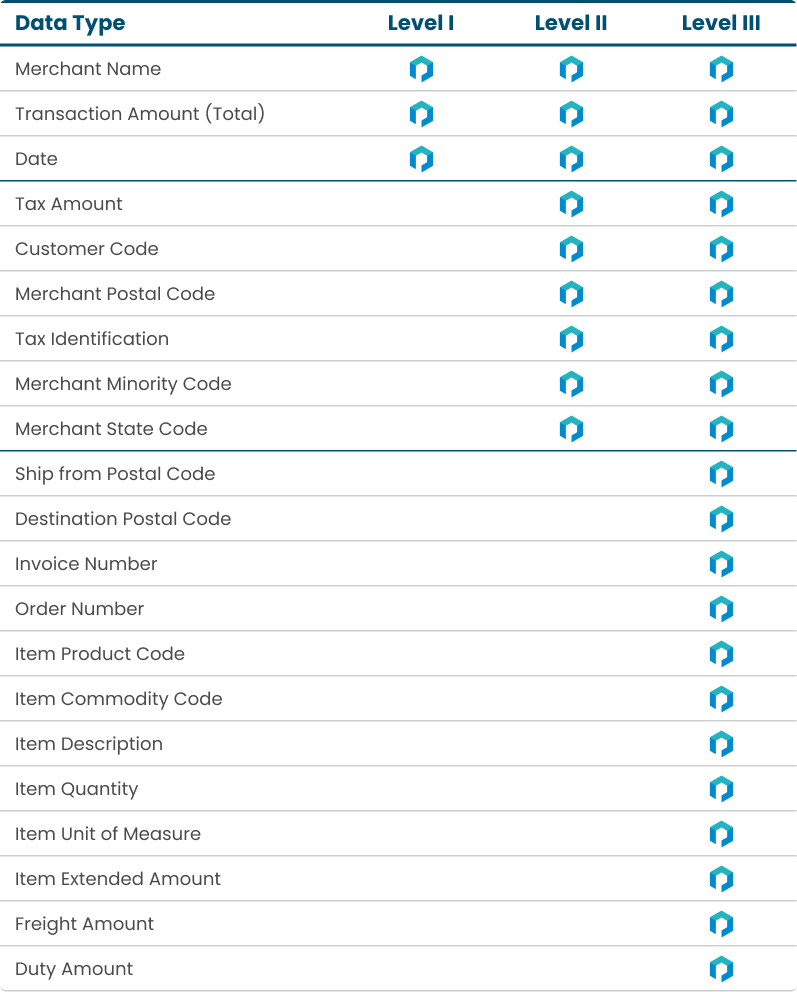
For SaaS platforms, the key is to collect and transmit the required addenda data to qualify for these optimized rates. This not only offers a route to reduced interchange but can be helpful in reducing chargebacks. Below are the types of addenda Data needed for L2 and L3 Processing:

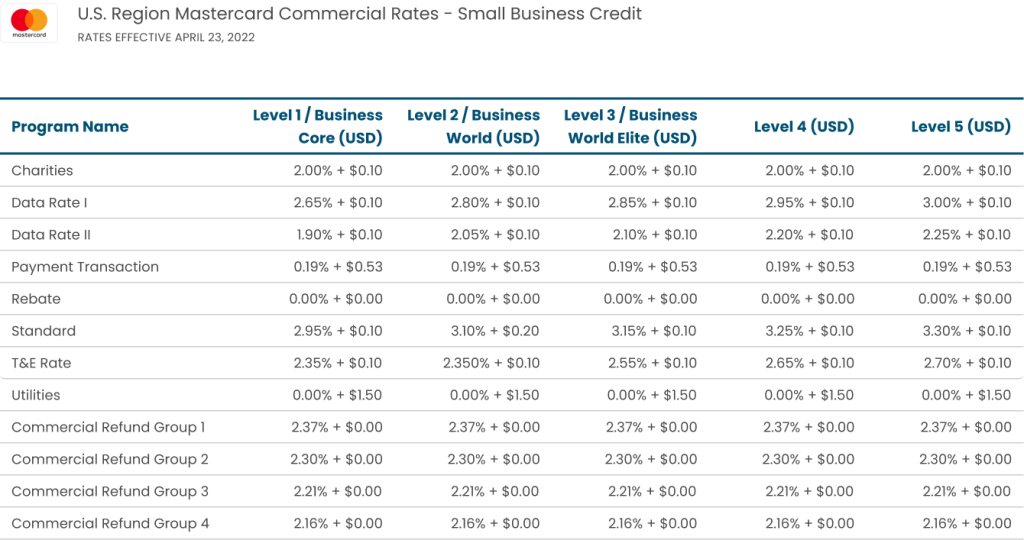
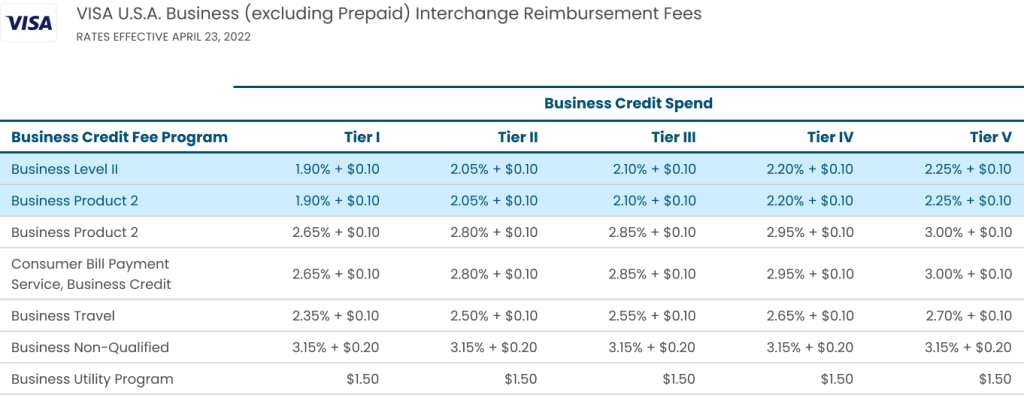
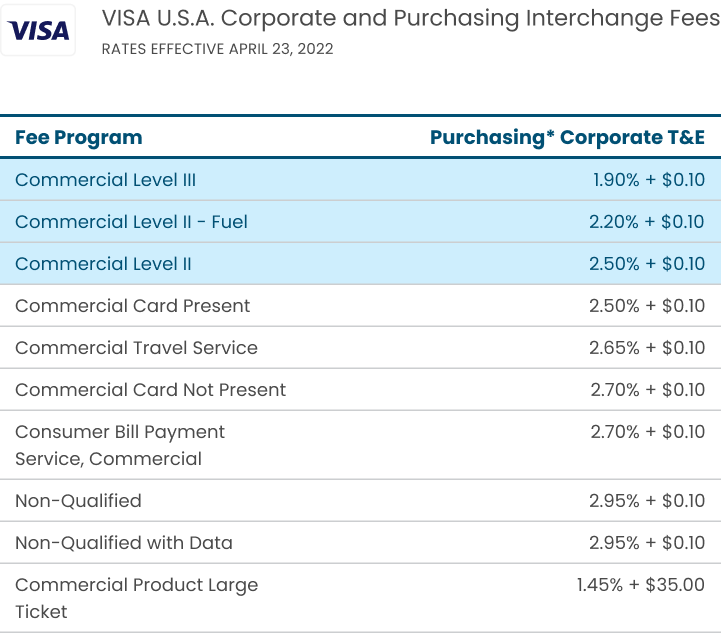
below are Interchange categories that qualify for L2 and L3 processing and their corresponding rates. If you’re curious the different Tiers (Visa) or Levels (MC) correspond to the amount of annual spend performed by that customer.

Now you can send all the addenda data you want, but unless your Payment provider is certified to transmit Level 2 and Level 3 data, you’ll won’t reap these benefits. If your platform’s merchants have any B2B commercial mix you’ll want to make sure your Payments infrastructure offers this capability.

The Wrap Up
At Payabli we often say we’re building the AWS for Payments. Our vision is that whatever Payments use-case a Software Platform has they can come to Payabli for best-in-class Payments technology and leverage as much or as little of our offering to suit their needs. Level 2 and Level 3 processing is just one example of the diverse solutions Payabli offers SaaS Platforms looking to make Payments a Core Part of their business model.

By qualifying for Level 2 and Level 3 processing, Vertical SaaS platforms can see significant reductions in interchange fees. These savings translate directly into better margins for your SaaS platform, making the effort in collecting and transmitting the required data well worth it.

Conclusion For Vertical SaaS platforms, transitioning to Level 2 and Level 3 processing isn’t just a technical adjustment but a strategic one. By ensuring the capture and transmission of the required addenda data, platforms can drastically reduce transaction costs and simultaneously offer greater value to their merchant base. It’s time to leverage these benefits and get ahead in the competitive SaaS landscape!

A Beginner’s Guide to Standard, Multi-Use, and Network Tokens

Introduction:

In the rapidly evolving world of online transactions, the need for robust data security measures cannot be overstated. One technology that’s been pivotal in safeguarding sensitive financial data is credit card tokenization. In this comprehensive guide, we explore three different types of credit card tokenization – standard, multi-use, and network tokenization. We’ll delve into their unique benefits, applications, and potential risks, and explain why they are critical in today’s digital economy.

Standard Credit Card Tokenization:

When it comes to secure online transactions, standard or single-use tokenization plays a significant role. Single-use tokens are unique to each transaction or merchant. With this method, every transaction generates a new token, thus minimizing the risk of credit card fraud. If a token is stolen or intercepted, it’s essentially useless for further transactions, greatly enhancing the security of online payments.

Multi-Use Tokenization:

Differing from standard tokenization, multi-use tokens are created for multiple transactions. A common feature in scenarios like recurring billing or frequent customer purchases, multi-use tokens provide convenience and efficiency. For example a Property Management Software’s whose customers are communities that may have multiple merchant IDs for different Use-Cases. Multi-Use tokens allow the residents of that community to have one card on file and use them across the different functions i.e. Paying rent, Paying for a special assessment, or paying to rent out the clubhouse for a party. While powerful for delivering better customer experiences, there is inherent risk with multi-use tokens because if one is compromised, all transactions associated with that token could potentially be at risk. This highlights the importance of stringent data security measures when dealing with multi-use tokens.

Network Tokenization:

Taking credit card security a step further is network tokenization. Programs like the Visa Network Tokenization Program offer tokens tied to the cardholder’s account and the specific device used for the transaction, enhancing security across different merchants. Network tokenization provides additional benefits, particularly for software companies.
Network tokens can easily be transferred if a company decides to switch payment processors. This feature eliminates the need to re-tokenize card data, saving time and resources. Additionally, network tokenization programs like Visa’s offer potential financial benefits, such as reduced processing fees, further incentivizing its adoption.
Network tokens also have the advantage of remaining secure even if the physical card is lost or stolen. The token can be instantly updated when card details change, ensuring uninterrupted online and mobile payment services.

Conclusion:

Grasping the concept of credit card tokenization is essential to building your payments strategy and can have wideranging implications on your business model. Fortunately, Payabli offers all three versions as part of our Payments Infrastructure offering and our team of Payments Experts are here to help you in understanding the gamut of tokenization options and how you can best leverage them to meet your Platform’s desired needs.

Calculating your Software Company’s Payments Revenue

Most Software companies find Payment Processing an opaque, confusing, and distracting business.

For instance, our Software partners often find Payments economics extremely murky. We’ve been in the shoes of our Partners and recognize that learning payments the “hard way” is not fun. As a result, we are passionate about shortening the learning curve for our Partners. Firstly, we want our Partners to truly understand how they are deriving their payments revenue. Secondly, we want them to understand how to maximize their payments revenue. Lastly, we want our partners to leverage Payments to enhance their product and customer experience.  

Here’s a simple heuristic to help Software companies calculate their latent payments revenue. This first iteration is for receivables, or what we call “Pay-In”. Stay tuned for expanded versions that incorporate different pricing strategies, interchange optimization, convenience fee scenarios and more. We’ll also be releasing a Payouts calculator showing economics for Card Issuing, Push to Card, Real Time Payments, ACH and more.

Give it a whirl and send us your feedback!  


Variable Descriptors

  • Monthly Processing Volume: The approximate amount of Credit Card volume ran per merchant. ACH and other payment types will be coming in V2! 
  • # of Transactions: This is the Average number of Credit Card transactions per merchant per month. 
  • Rate Charged: You can employ various pricing models and strategies for different use-cases and scenarios, however we’re sticking to a simple Flat-Rate pricing model for this calculator. 
  • Auth Fee Charged: The Auth Fee, short for Authorization Fee, is a per transaction fee charged to the end merchant. Market rate is usually between $.10 and $.30. 
  • Revenue Shared: What’s your revenue split with  your payments “backbone”? Our goal is to make payments a primary revenue driver. Contact Sales for details on our lucrative rev-share programs!
  • Interchange Rate: Interchange is a “wholesale” cost of processing charged by the Card Issuing Bank. There are hundreds of Interchange categories influenced by various factors. There’s a lot of great articles online detailing Interchange, but we personally like this one from CardFellow.
  • Buy Rate: Buy Rate is a loaded term. In this calculator we define it as the discount percentage markup that you pay to your payments backbone.  Buy Rates are covered before they start to share revenue with you. Because of this incongruence we’re not huge fans of Buy Rates. 
  • Dues & Assessments: Dues & Assessments are also “wholesale” costs charged by the Card Associations, however we’re limiting this to Assessments for simplicity. There’s a number of other nominal fees within this category.

What Culture Means to Us

Culture. This single word is talked about extensively and we believe it should be, because it is important. The world is changing and it’s important to recognize that we have to change and evolve with the times. Great talent is motivated by more than money, they want a stimulating endeavor to work on and they want to be surrounding by impassioned colleagues. It all starts with identifying what culture means to your organization and hiring great people to fit that dynamic.

Payabli defines a great culture as a place where team members love coming into work every day and have a hand in solving big problems. The big problem we are solving is to make it easier for businesses to pay, get paid and in that process let them take over their payment stack. We strive to attract team members that look forward to Monday mornings, ready to do great work and tackle big challenges with their team members. We strive to create an environment where they feel empowered, a place where their voice counts, and a place where their direct efforts impact the well being of everyone on the team and our customers.

Culture is incredibly important at a startup stage all the way through its maturing process. We think a lot about what core responsibilities our company has towards our team. As a result we always come back to learning and why we believe a great culture should embrace continued education. This education can come in any shape or form with the ultimate emphasis on ensuring our team members are learning something they will get satisfaction and grow. Perhaps the learning comes in the form of a coding course, reading a book on just about anything, learning how to sail, how to sketch, how to produce movies, etc. Ultimately we hope our team strive to learn and we believe that satisfaction is priceless.

There is a lot more to share on culture, and we look forward to challenging ourselves on how we can do better.

We look forward to sharing more on this important subject.

Our Guiding Principles- Things that matter

We think it is important to share something dear to our hearts as it gives us our purpose.

Things that matter to us (Our Guiding Principles):

We want a vibrant culture where employees love coming to work every single day

  • At Payabli, employees treat each other with respect, can prosper monetarily, and are constantly learning and achieving self efficacy   
  • Employees form strong friendships with colleagues
  • A sound work-life balance is not encouraged it’s required
  • We hire good people: integrity, intelligence, fun, and caring are qualities we seek out in employees
  • We want all of our employees to be successful in numerous facets of life; we will invest in their development with programs such as: 
      • Personal Finance and money management 
      • Fitness and mindfulness 
      • Goal fulfillment and self efficacy 
      • Continued education
      • Giving back

We want to woo our customers and in turn we want them to write us love letters

  • We purposely go out of our way to make clients feel loved
  • Employees are guided by wanting rather than needing to help, going above and beyond to serve customers comes as second nature 
  • We use the Payabli “Deal Paradigm” as a blueprint for every partnership: Fair share of value, proportional share of risk, and alignment of upside incentive
  • We are selective with which customers we take on, quality is more valued than quantity

We want to build a sustainable organization that has a strong sense of purpose and is long term in thinking 

  • We want our reputation to proceed ourselves and as a result be the premier PAAS (Payments as a Service) product in the Industry 
  • We want to be a “Small Giant” where we have control of our destiny and to not cave to external pressures to grow and compete   
  • We covet and protect our reputation our word is bond