

Guest Post by Ershad Jamil | Former CGO, ServiceTitan
Key takeaways
- As AI makes software features easy to copy, embedded finance is the most durable layer vertical SaaS can own, because it ties your revenue to your customers’ transactions, not to whether they renew.
- 88% of organizations now use AI, so a feature-only moat no longer holds.
- Embedded payments grow your revenue as your customers grow and make your platform far harder to leave.
- The strongest platforms own three layers: a system of record, embedded finance (payment acceptance, accounts payable, and payment operations), and AI-driven workflows.
For the better part of the last decade, vertical software companies operated on a relatively simple and highly effective model: build a great product, charge a monthly subscription, and scale recurring revenue. It was clean, predictable, and, for many, incredibly successful.
But that model is starting to show cracks, and AI is accelerating the shift.
Why is subscription-only SaaS losing its edge in the age of AI?
We’re entering a world where software features are easier to build, faster to replicate, and increasingly commoditized. What once required years of engineering investment can now be developed in a fraction of the time. As that happens, the durability of pure subscription revenue comes into question. If your differentiation is primarily feature-based, it’s becoming harder to defend over time.
The pressure is not theoretical. AI use inside organizations climbed from 78% to 88% in a single year, and as those capabilities spread, the features that once set a platform apart get matched far sooner.
That doesn’t mean SaaS is going away. It means it’s no longer enough on its own.
How did embedded finance go from optional to essential?
Long before the current wave of AI, there was an emerging idea that many software companies initially resisted: embedding financial technology directly into their platforms.
A decade ago, this felt like a departure from the core SaaS playbook. Payments, in particular, introduced a very different monetization model. Instead of charging a fixed monthly fee, revenue became tied to customer outcomes. You made money when your customers processed transactions, when they got paid.
For founders used to predictable subscription revenue, that felt uncertain. It introduced complexity around compliance, underwriting, and operations. It wasn’t obvious that the tradeoff was worth it.
But over time, something important became clear. Software that helps businesses operate is valuable. Software that helps businesses make money and manage money is indispensable.
What turns a software feature into financial infrastructure?
Today, embedded FinTech is no longer a “nice to have.” It has become one of the most powerful levers for growth and retention in vertical software. When you enable a customer to accept payments, pay vendors, manage cash flow, and reconcile transactions directly within your platform, you move from being a tool to becoming part of their financial infrastructure. That shift changes everything.
Revenue becomes more aligned with your customer’s success. As they grow, you grow. As they process more transactions, your monetization expands naturally. Just as importantly, your product becomes significantly harder to replace. Financial workflows are deeply embedded, and once they’re integrated into daily operations, switching costs increase dramatically. This is why so many of the most successful vertical SaaS companies today are also, in many ways, financial platforms.
Does AI replace embedded finance, or amplify it?
There’s a tendency to think of AI as a replacement for traditional software value. In reality, it’s more of an accelerant. AI is transforming how work gets done inside software. It can automate scheduling, follow up with leads, generate invoices, and even assist in closing sales. But all of those workflows ultimately lead to a single outcome: a transaction. And transactions require infrastructure.
As AI increases the speed and volume of business activity, the importance of seamlessly handling payments, payouts, and financial operations only grows. You don’t just need to enable transactions. You need to manage them intelligently, reconcile them in real time, and provide visibility into what’s happening across the business.
In that sense, AI drives the workflow, but financial technology completes it. We go deeper on this in how AI is transforming embedded payments.
What does the modern multi-product SaaS platform look like?
What’s emerging is a new standard for vertical software companies. The most resilient platforms are no longer built around a single product or revenue stream. They combine multiple layers of value:
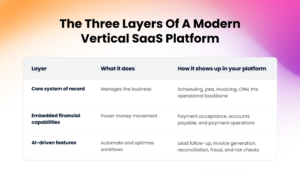
This combination creates a powerful dynamic. AI increases efficiency and drives more activity within the platform. Financial infrastructure monetizes that activity. And the core software anchors everything in a single, cohesive experience. The result is a more diversified business model, stronger customer alignment, and a much more defensible position in the market.
Why is payment infrastructure the unlock?
Despite the clear benefits, building financial technology in-house is not trivial. It requires navigating regulatory requirements, managing risk, supporting multiple payment methods, and building the operational backbone to handle it all. That’s where infrastructure providers have become critical to the ecosystem.
Companies like Payabli are designed to abstract away that complexity. By offering capabilities like Pay In, Pay Out, and Pay Ops in a unified platform, they allow software companies to embed financial functionality without having to become full-fledged payments companies themselves.
This isn’t just about faster time to market, though that matters. It’s about enabling software companies to deliver a seamless, end-to-end experience for their customers, from the moment work is created to the moment money moves and is reconciled. And the opportunity sits squarely with this layer: Bain estimates revenue for software platforms and the infrastructure powering embedded finance has roughly doubled, from about $22 billion in 2021 toward $51 billion.
What does it mean to become an economic platform?
The broader shift happening right now is not just technological, it’s structural. Vertical SaaS companies are evolving from software vendors into economic platforms. They’re not just enabling workflows; they’re participating directly in the financial lifecycle of their customers’ businesses. That shift fundamentally changes how value is created and captured.
In a world where AI continues to compress the advantage of pure software features, the companies that win will be the ones that go deeper, those that own not just the workflow, but the outcomes tied to it.
AI will reshape software in profound ways. It will make products smarter, faster, and more capable than ever before. But it won’t change the fundamental reality of how businesses operate. Companies still need to get paid. They still need to move money. They still need clarity and control over their financial operations. The opportunity, and increasingly the requirement, is to bring all of that into a single, cohesive platform.
Because in the next era of software, it won’t be enough to simply power the workflow. You have to power the business behind it.
How does Payabli complete the stack?
Payabli provides that layer for vertical software companies. A single API unifies payment acceptance, accounts payable, and payment operations, so a platform can embed and monetize payments without the cost or complexity of becoming a full payments company. Platforms that have made the move see it in their numbers, from Builder Prime’s 1,000% increase in payment volume to Sunbound moving payor adoption from 50% to 90% in under a month.
If embedded finance is the layer you’re ready to own, book a demo to see what it looks like for your vertical.
And stay tuned for my next article in the series: why the cost-reduction story is only half of it, and how AI is becoming one of the most powerful revenue levers a platform can pull.